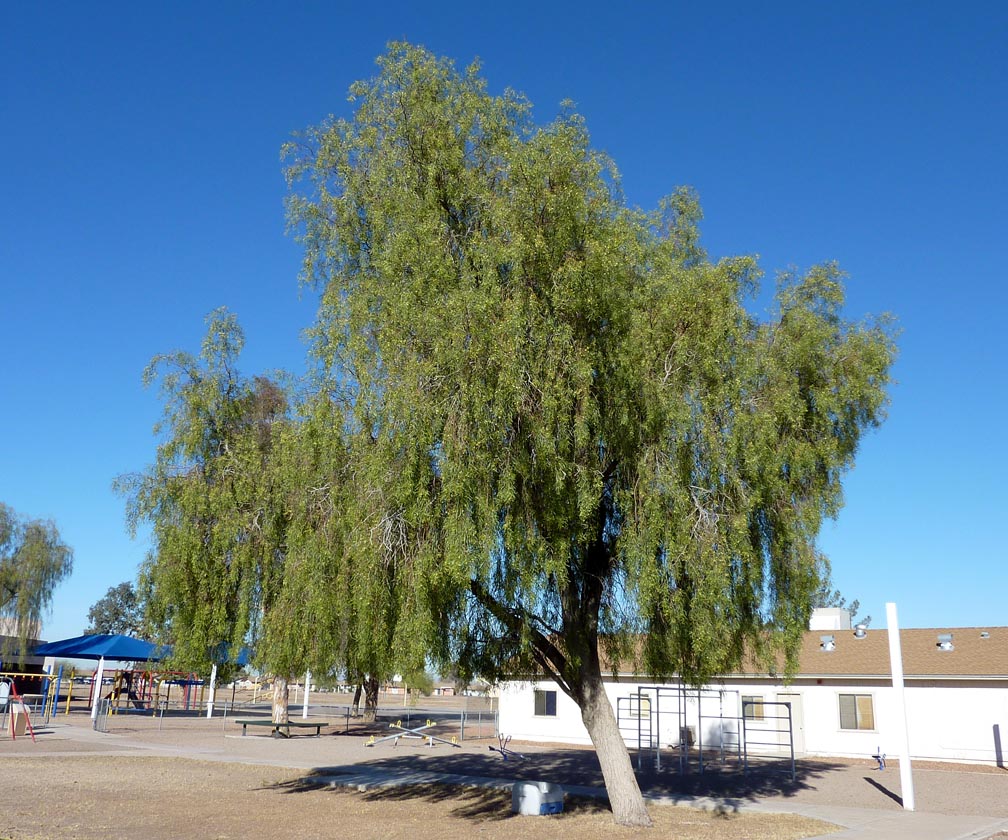
Scientific: Acacia salicina (Synonyms: Acacia cyanophylla, Mimosa saligna, Racosperma salignum)
Common: weeping acacia, willow wattle, Port Jackson willow, Australian willow
Family: Fabaceae (Leguminosae)
Origin: Widely distributed across eastern Australia
Invasive Alert: Like its Phoenix landscape cousin, Acacia stenophylla, weeping acacia is a pesky colonizer and can reseed or grow epicormic shoots or root suckers from roots in and around irrigated Phoenix urban landscaped areas forming dense, rapidly-spreading, monospecific stands that can locally spread.
Pronounciation: A-KAY-sha sal-a-SEE-na
Hardiness zones:
Sunset 8, 9, 13-24
USDA 9-11
Landscape Use: Weeping acacia is a serviceable, upright, accent tree, usually single or sometimes with multiple trunks. Its a good tree if well trained when young for more narrow vertical spaces, patio tree, streetscape tree, background, screen, xeric or oasis landscapes.
Form & Character: Variably upright, graceful, pendulous (weeping) with a mostly strong vertical form, yet form and shape can also be quite variable (clumsily rounded and spreading) because of seed propagation.
Growth Habit: Evergreen, woody, broadleaf (though phyllodes are quite narrow) perennial tree, vigorous and fast growing tree, upright to 50-feet tall with less than equal spread. Major branches are often acutely upright with weak attachments and dangerous bark inclusions, but branch ends are pendulous.
Foliage/Texture: Phyllodes are lanceolate to linear, ranging in color from light gray-green to glaucous blue-green, 6- to 10-inches long, sometimes cork screw like, trunk generally grayish brown, smooth when young, weak wooded; medium fine texture.
Flowers & Fruits: Numerous, clustered raceme (15 to 25) of yellow-green to cream flowers in globular heads on glabrous to mealy peduncles 1/2-inch long in axillary racemes, rarely 1 to 2 flower heads in the phyllode axils. Fruits are pods of variable lengths, usually 1- to 5-inches long to 1/2-inch wide, somewhat constricted between seeds, sometimes flattened, sometimes curled.
Seasonal Color: Light visual display of flowers in during winter, sometimes beginning as early as late November.
Temperature: Heat tolerant, cold hardy to 16oF.
Light: Full sun
Soil: Tolerant of most local soil types.
Watering: Infrequent deep irrigations during summer, otherwise none. Use irrigation water application volume to control growth rate.
Pruning: In especially commercial landscapes with vehicular and pedestrian traffic flows, the crown of weeping acacia will need to be raised sometimes to heights of 20 feet or more to counteract its dominate pendulous habit. When crown raising, remove branches with excessively acute angle attachments to avoid future catastrophic limb failure and subsequent wood rot.
Arborist warning: Weeping acacia needs rigorous training (even staking) when young to establish a self-supporting, structurally strong and upright habit as young stems and branches are pendulous, tend to originate from acute-angled branch connections, and cross over one another. That this tree in Phoenix (even well-trained specimens) is prone to catastrophic limb failure when mature cannot be over stated.
Propagation: Germinates readily after acid scarification.
Disease and Pests: Numerous root and crown rot bacteria or fungi pathogens WILL infect weeping acacia wood if soil is excessively wet or poorly drained, or if catastrophic limb failure has occurred.
Additional comments: Weeping acacia is a useful tree in urban landscapes because of upright, generally cylindrical form. Young trees are weak-wooded and grow vigorously. Mature trees are prone to wind damage during summer monsoon storms. Strengthen wood by watering less frequently to slow growth and pruning limbs with acute branch angle attachments when young. The latin word "salicis" means pendulous to willow-like habit.
Taxonomic note: Acacia is a grouping with over 1350 species and more than 2000 published botanical names. There are over 960 species of Acacia in Australia alone. However, early 21st century taxonomic reorganization of the genus Acacia removed and reclassified all former new world Acacia species with compound leaves into other genera.