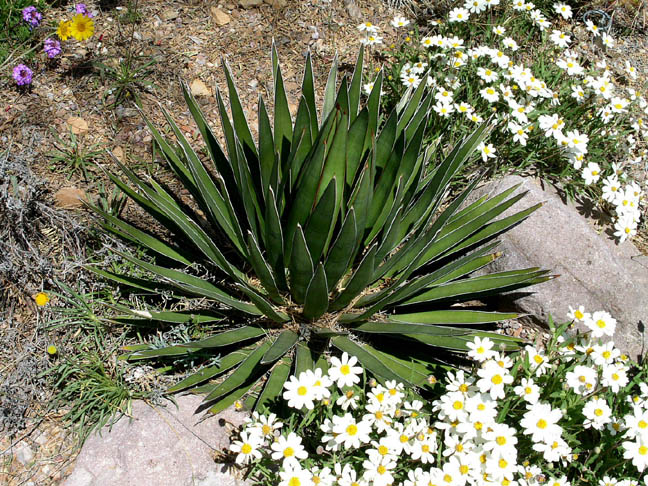
Scientific: Agave ocahui
Common: no common name
Family: Asparagaceae (subfamily Agavoideae)
Origin: Rocky hillsides of northeastern Sonoran Desert to 4,500 feet in elevation, principally in Sonora, Mexico.
Pronounciation: A-GA-ve o-ca-HU-i
Hardiness zones:
Sunset 10, 12-24
USDA 8 (sometimes injured)-11
Landscape Use: This is a great small agave for desert gardens and patio containers, and even narrow street medians. It is used principally as a nice small accent or specimen agave.
Form & Character: Rosetting basal habit, elegant and classy.
Growth Habit: Evergreen, herbaceous perennial, monocarpic, slow, rosette to 1.5-feet tall with a 2-feet spread at maturity. Does not produce basal off shoots.
Foliage/Texture: Rosettes of narrow, strap-shaped green leaves lacking serrations on the leaf margins. Variety ocahui has white marginal filaments on its leaves; medium coarse texture.
Flowers & Fruits: Elongated, terminal yellow flower stalk to 10- to 15-feet tall after many years, flower stalk unbranched (image by Chris P. Martin). Stalk is colorful, but not necessarily the most ornamental of agave flower stalks.
Seasonal Color: None
Temperature: Injured below 15oF or above 115oF.
Light: Light, filtered shade to full sun.
Soil: Any soil type, but thrives best if soils are well-drained.
Watering: Only limited supplemental irrigation during summer months is needed to keep plants looking healthy.
Pruning: None
Propagation: Seed
Disease and Pests: Basal fungal and bacterial stem and root rot.
Additional comments: This is a fantastic small agave for those smaller 'up close and personal' landscape spaces. It is used in the landscape much the
same as Agave geminiflora or Agave macroacantha, but with different textural
and color characteristics. Its leaves are a source of strong fibers (the word 'ocahui' is literally translated to mean 'cord'). The leaves contain saponin smilagenin which can be used as a detergent.
There are two varietal selection of Agave ocahui: