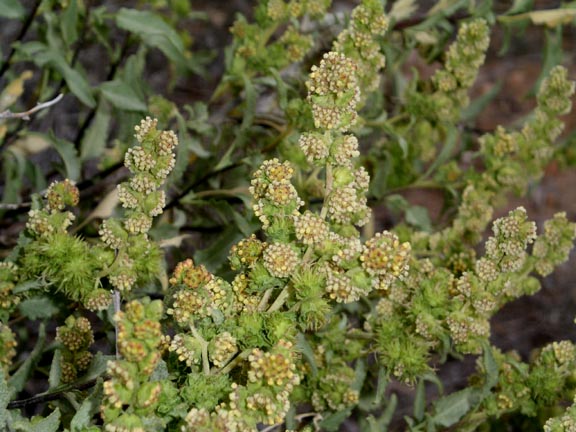
Scientific: Ambrosia deltoidea
Common: triangle bursage, canyon bursage, rabbit bush
Family: Asteraceae
Origin: Lower Sonoran Desert foothills and slopes, central Arizona into
Sonora Mexico and west into eastern California and Baja California.
Pronounciation: Am-BRO-see-a del-TOY-dee-a
Hardiness zones
Sunset 11-13
USDA 9-10 (arid zones only)
Landscape Use: Xeric landscape plantings as a low-growing and spreading filler plant, native lower Sonoran Desert habitat restoration projects including desert slope stabilization, mass xeric and native plantings, highway medium plantings, and other local, generally dumpy, wayward sites.
Form & Character: Small, rounded, dome-like, mounding, symmetrical, arid, desert, not expressive, dull and uninspiring.
Growth Habit: Evergreen, semi-woody perennial subshrub, mostly biological active during winter and quiescent during summer, moderate growth rate to 1-foot to 2-feet tall with slightly greater spread. Irrigating triangle bursage will increase its rounded, dome-like size significantly.
Foliage/Texture: Leaves are alternately arranged, simple, evergreen, distinctly triangular or with a wedge-shaped base, gray-green, occasionally revolute to 3-inches long, but generally smaller; medium fine texture.
Flowers & Fruits: Terminal clusters of small yellow-green flowers in December to April. Fruit pea sized with hooked spine, inconspicuous.
Seasonal Color: More heavily vegetated in winter. Otherwise no accent or color features.
Temperature: Tolerant to 22oF
Light: Full sun
Soil: Slopes and porous fast draining soils are best. Avoid planting at the base of landscape swales where soil drainage might be poor.
Watering: Little is needed after establishment. Only rarely irrigate during the winter if winter rains fail to materialize, otherwise responds well to supplemental water during the summer. But be careful as too much extra water will encourage rank growth.
Pruning: Generally none, but slight shearing during the fall before onset of winter growth is used to increase landscape symmetry.
Propagation: Seed or softwood cuttings.
Disease and Pests: Root rot in poorly drained soils is common.
Additional comments: Triangle bursage is generally without any outstanding accent features and is not a plant for use in mesic garden themes. It is best used as a companion filler plant for native desert restoration projects and landscape plantings away from people. Triangle bursage is the principal nurse plant for saguaro at Organ Pipe National Monument. Its shade reduces maximum soil surface temperatures, and it also provides a microhabitat with elevated soil nitrogen levels.
Allergy alert: Recently, many landscape architects have taken to specifying Ambrosia in native landscape planting designs around Phoenix. However, Ambrosia plants including triangle bursage have
foliage that is allergenic causing an acute airborne contact dermatitis for many people.