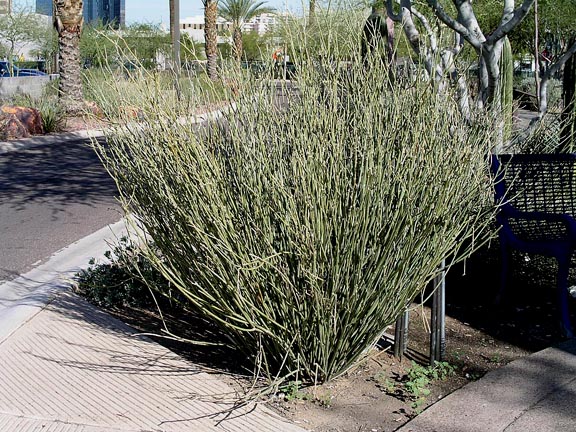
Scientific: Asclepias subulata
Common: desert milkweed, rush milkweed
Family: Asclepiadaceae
Origin: Sandy washes in the arid regions of the southern intermountain
west at lower elevations below 3,000 feet including the upper reaches of the Sonoran
Desert, eastern California, southern Nevada and into Baja California.
Pronounciation: A-SCLE-pee-us sub-u-LA-ta
Hardiness zones
Sunset 11-13
USDA 9-11 (arid zones only)
Landscape Use: Seasonal accent plant (mostly line and texture) for dry landscapes.
Form & Character: Erect, stiff, open, airy, and informal.
Growth Habit: Herbaceous perennial, generally basally clumping and erect. Moderate grower from 2- to 5-feet tall. If it's irrigated regularly, then it will respond with increased vigor and size and become quite large and "leggy".
Foliage/Texture: Green to gray green stems, entirely leafless except for new growth; medium fine texture.
Flowers & Fruits: Small, terminal creamy yellow flowers forming flat-topped umbels during spring through fall. Fruit is horn shaped to 3-inches long.
Seasonal Color: A very subtle flower accent during growing the season, but most evident during spring.
Temperature: Very heat tolerant, cold tolerant to 18oF.
Light: Full sun.
Soil: Prefers sandy, well-drained soils, but will grow well in pretty much any Phoenix soil type.
Watering: Little to none. Plants that are irrigated have a much enhanced growth rate.
Pruning: Head back severely to rejuvenate every 3 to 5 years.
Propagation: Seed, stem cuttings.
Disease and Pests: None, except occasional aphids on juicy flower stalks.
Additional comments: Desert milkweed is currently quite popular as a desert accent plant. Its stems produce latex that is a source of rubber and might cause a minor dermatitis upon contact with the skin. This interesting plant attracts all kinds of flying wildlife from bees, wasps, and assasin bugs to butterflies, and is in particular a forage plant for the monarch and striated queen butterflies.
Factoids for Plant Nerds: There are 73 species of Asclepias found in the United States at many different elevations. The genus Asclepias is named after the greek god Asklepios, the ancient god of medicine.