Scientific: Baileya multiradiata
Common: desert marigold
Family: Asteraceae
Origin: Utah to southern California, Texas to northern Mexico below 5,000 feet in elevation.
Pronounciation: Bay-LEE-a mul-ti-ra-di-A-ta
Hardiness zones:
Sunset 11-13 as winter annual
USDA 9-10 (arid zones only)
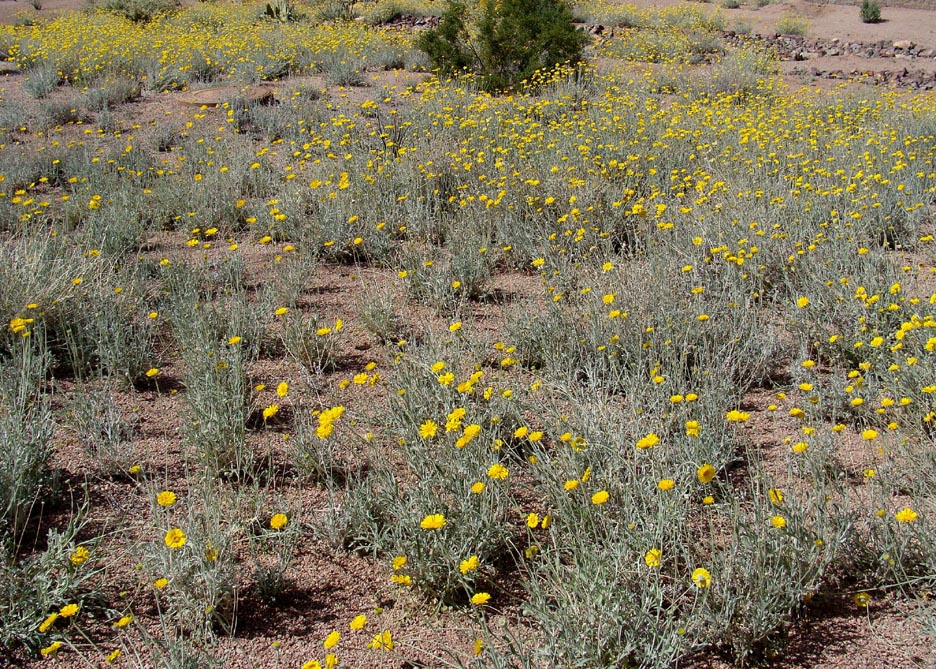
Landscape Use: Xeric annual or perennial used best as a low growing accent, dry or native garden bedding plant, native wildflower gardens and native landscapes, Sonoran Desert native habitat restoration, or cut flowers.
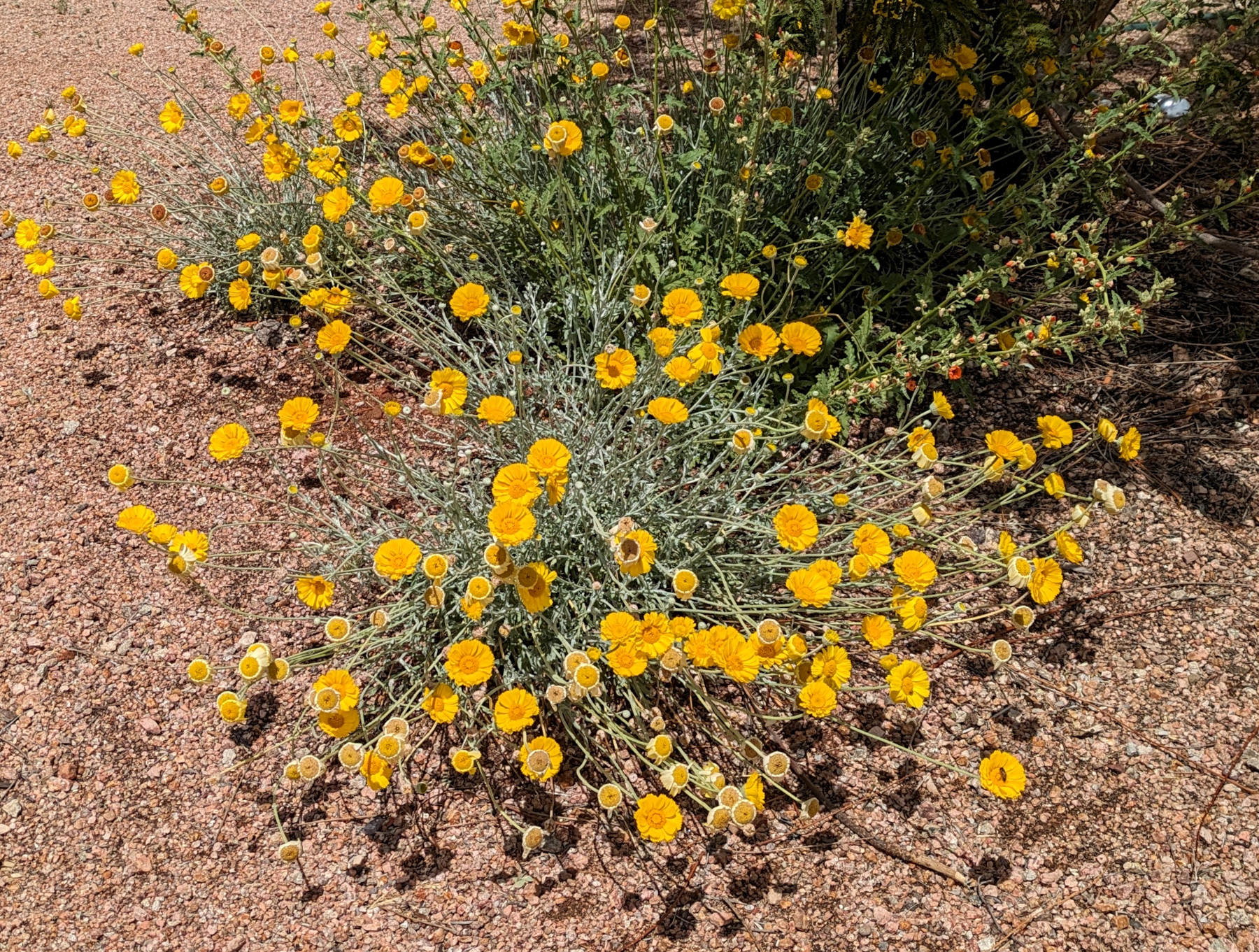
Form & Character: Clumping and rosette forming, free flowering, light and airy, diminuative, gray and recessive, informal, naturalistic.
Growth Habit: Herbaceous perennial to less than 6-inches tall, grows a tufted rosette of leaves giving way to flower peduncles to 20-inches long in later winter and spring. Active growth during fall, winter and spring, nearly quiescent to dormant during summer. Growth rate and eventual size and vigor strongly altered by water availability.
Foliage/texture: Desert marigold grows basal foliage that is pinntified, highly tomentose and glaucous (grayish white in color). Occasionally, leaves are found along the flower peduncle; medium fine texture, but more coarse if more water is applied.
Flowers & fruits: Copious yellow ray flowers to 2 inches in diameter, each on a peduncle stalk, as many as 20 to 50 flowers per plant most of year; fruits are achenes.
Seasonal color: Dappled yellow in late winter through mid-spring. Sporadic blooms rest of year when given supplemental water.
Temperature: In Phoenix, desert marigold is mostly biologically active from November through the following May when temperatures are below 85oF. In contrast, desert marigold will transition to dormancy during late April and May when temperatures regularly exceed 95oF unless frequently irrigated and situated in a sheltered location.
Light: Full sun, no partial sun or shade.
Soil: Well-drained soil is an absolute must!
Watering: Little to none if enough winter rainfall occurs. Do not overwater. Excessive irrigation causes rank vegetative growth and leads to weak, elongated, limp, flower stalks; withholding water in summer induces seasonal dormancy.
Pruning: None, except to remove spent flowers if you're a landscape neat freak.
Propagation: Seed
Disease and pests: Root rot in poorly drained soils, otherwise disease and pest free.
Additional comments: Desert marigold is a Sonoran Desert native perennial whose winter-spring blooming period is typically extended in urban settings because of increased availability of water. Not surprisingly, desert marigold can readily reseed
and naturalize in urban Phoenix landscapes.
Taxonomic tidbit: The genus name Baileya is from Jacob Whitman Bailey (1811-1857), early American microscopist.