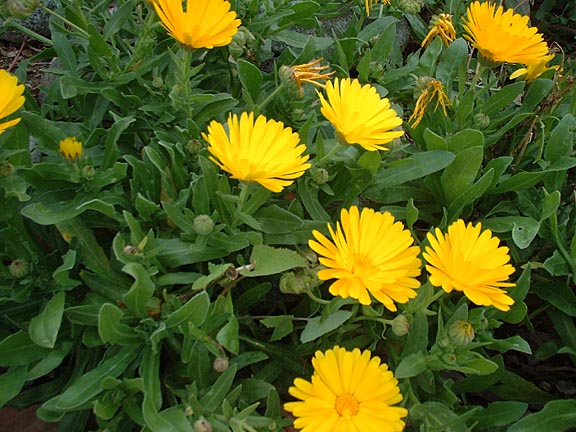
Scientific: Calendula officinalis
Common: pot marigold
Family: Asteraceae
Origin: South Europe, north Africa to Iran
Pronounciation: Ca-LEN-du-la of-fi-ci-NAL-is
Hardiness zones
Sunset All
USDA All
Landscape Use: Winter bedding plant to impart warm splashes of color. Best planted in masses of the same flower color.
Form & Character: Bushy and compact to open and ranging depending on cultivar, bright, cheerlful, festive, warm, familiar daisy-like flowers.
Growth Habit: Pot marigold is an evergreen, herbaceous annual. Growth and habit depends on cultivar, ranging from dwarf and rosetting to upright and branched, 12 inches to 3-feet tall.
Foliage/Texture: Medium to dull green oblong leaves, size variable depending on temperature and moisture, pubescent, aromatic, and viscid to the touch; medium texture.
Flowers & Fruits: Single or double ray flowers to 4-inches across, colors include orange, apricot, cream and soft yellow. Flowers more yellow in warm weather. Fruit contain multiple, oblong greenish seeds.
Seasonal Color: Flowers in winter and spring.
Temperature: Prefers 35o to 85oF.
Light: Full sun
Soil: Light and well-drained soils are best.
Watering: Regular
Pruning: None, except to perhaps remove spent flowers before fruit development to prolong blooming period.
Propagation: Seed, can naturalize under right conditions in Phoenix. Naturalizes easily in Southern California. Here is a digital image captured by me during March 2009 of blooming pot marigods in the front yard of my parent's next door neighbors house in southern California that were initially sown from seed by my mom in my parents backyard in the early 1960s. That's right, they come back every year and move around the neighborhood.
Disease and Pests: Mealy bugs, aphids, sow bugs, leaf miners.
Additional comments: Pot marigold easily reseeds in landscape garden flower beds. They are best planted from nursery cell packs. Dwarf strains grow to only 12- to 15-inches tall at maturity. There are many named cultivars. Calendula is an old-fashioned garden annual that made a popular comeback during the last 10 years due to the introduction of dwarf, double-flowered cultivars.
Interesting culinary and biomedicinal tidbits: The petals of pot marigold are known to be edible and are sometimes used as garnishes, though not very tasty. They are also used as a saffron substitute to color and flavor foods and also for yellow dye to color paper and fabrics. Pot marigold also has medicinal uses. It has been used for the treatment of skin disorders and pain, and as a bactericide, antiseptic and anti-inflammatory. The petals and pollen contain triterpenoid esters (an anti-inflammatory) and the carotenoids flavoxanthin and auroxanthin (antioxidants, and the source of the yellow-orange coloration). The leaves and stems contain other carotenoids, mostly lutein (80%) and zeaxanthan (5%), and beta-carotene. Finally, as a cosmetic it is a great skin soother and softener, and is used in salves and lotions.