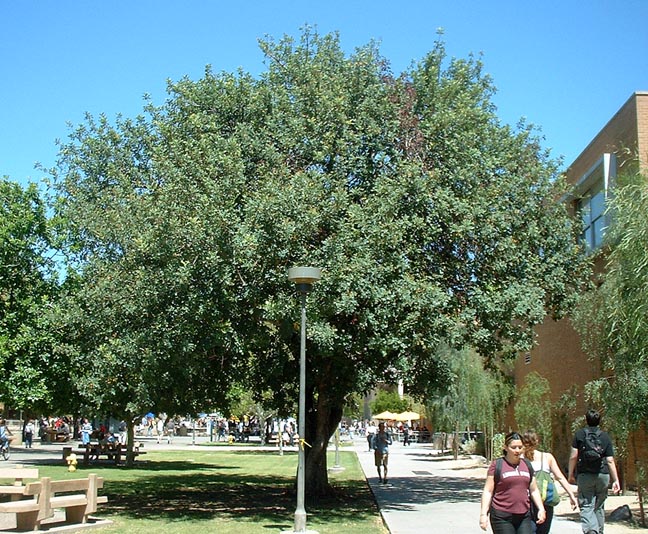
Scientific: Ceratonia siliqua
Common: carob tree, St. John's bread, locust tree
Family: Fabaceae (Leguminosae)
Origin: eastern Mediterranean
Pronounciation: Ser-a-TOE-nee-a sa-LI-qua
Hardiness zones
Sunset 9, 13-16, 18-24
USDA 9-11
Landscape Use: Dense shade tree for xeric landscape design themes.
Form & Character: Somewhat rounded, definitely spreading, rugged, stiff and coarsely branched, tough, leathery, aromatic (like dead fish with chocolate surprises).
Growth Habit: Evergreen, woody, broadleaf perennial tree, moderately-fast growing to 20- to 40-feet tall with greater spread. Prolific producer of epicormic shoots (basal trunk and root suckers).
Foliage/Texture: Alternate, leathery, even pinnately compound leaves, 4- to 6-inches long, leaflets in pairs of 2 to 3, leaflets are orbicular to obovate, petioles and rachis are reddish; medium coarse texture.
Flowers & Fruits: Carob tree flowers are bisexual, yellowish green maturing to red in color, and are arranged in short lateral racemes during the late fall and early winter on short inner spur branches of the tree. Often flowers exude a powerful musty fragrance (like dead fish, wet dogs, or that musk perfume that some of the granola mamas from northern California wear). Carob tree fruit are a flattened, twisting, and elongated pod to several inches long, green when immature but then maturing to a dark brown color. The pulp between the seeds inside mature fruit pods is edible, tasting like chocolate.
Seasonal Color: None
Temperature: This tree thrives in the heat and cold of the lower desert.
Light: Full sun
Soil: Tolerant of moderate soil alkalinity, but will show foliar chlorosis in alkaline soils if the soils are chronically wet as might be the case around lawns.
Watering: Though drought tolerant, carob tree responds well to some infrequent deep irrigations during summer.
Pruning: Conservatively raise the crown base as needed and remove any epicormic shoots (sucker growth). Agressive pruning of larger mature trees leaving large and gaping wounds will likely result in systemic crown rot and/or trunk and branch sunscald unjury.
The delimma: Over time the spatial fragmentation (i.e. densification) of the Phoenix urban fabric has increased, meaning new landscape spaces for planting landscape taxa are becoming smaller. This is problematic for wide spreading tree taxa such as carob tree, palo verde, Indian laurel fig, and even mesquite. This problem is mostly resolved by the 'Horticultural clods of Phoenix' (aka 'Hort clods') by increased pruning in attempts to conform wide spreading taxa to smaller spaces. Unfortunately, this practice predisposes tree taxa such as carob tree to increased incidences of trunk and branch sunscald injury (as well as other disease pressures).
Disease and Pests: Systemic trunk, crown and root wood rotting fungal and bacterial diseases are common within poorly managed carob trees.
Additional comments: Carob tree is a wide-spreading tree. In Phoenix, carob tree is one of the best trees for casting a dense shade where water resources are limited. Carob tree does however have a 'few skeletons in its closet'. It has roots that are known to be invasive and its flower, fruit and leaf litter can be a debris problem in this age of the 'immaculate landscape'. In Phoenix, it also has the potential in the presence of canopy cover and moist soil to reseed. Presently, carob tree is not popular in the Phoenix nursery/landscape trade. My guess is that it comes from the 'wrong' desert.
Taxonomic linguistics: The word carat, which is still used today to measure gold and diamonds, comes from the Arabic name for the carob seeds because of their uniformity in weight.
Some culinary history: Commercial carob chocolate is derived from the fruit pods. The carob tree fruit are sometimes referred to as "locusts" or "St. John's Bread." The Bible records in Mark 1:6 that John the Baptist ate "locusts and wild honey" as part of his simple vegetable diet. Also, the husks that were eaten by the Prodigal Son in Jesus' parable (found in Luke chapter 15) were discarded carob pods. Even today carob continues to be an important feed for livestock.