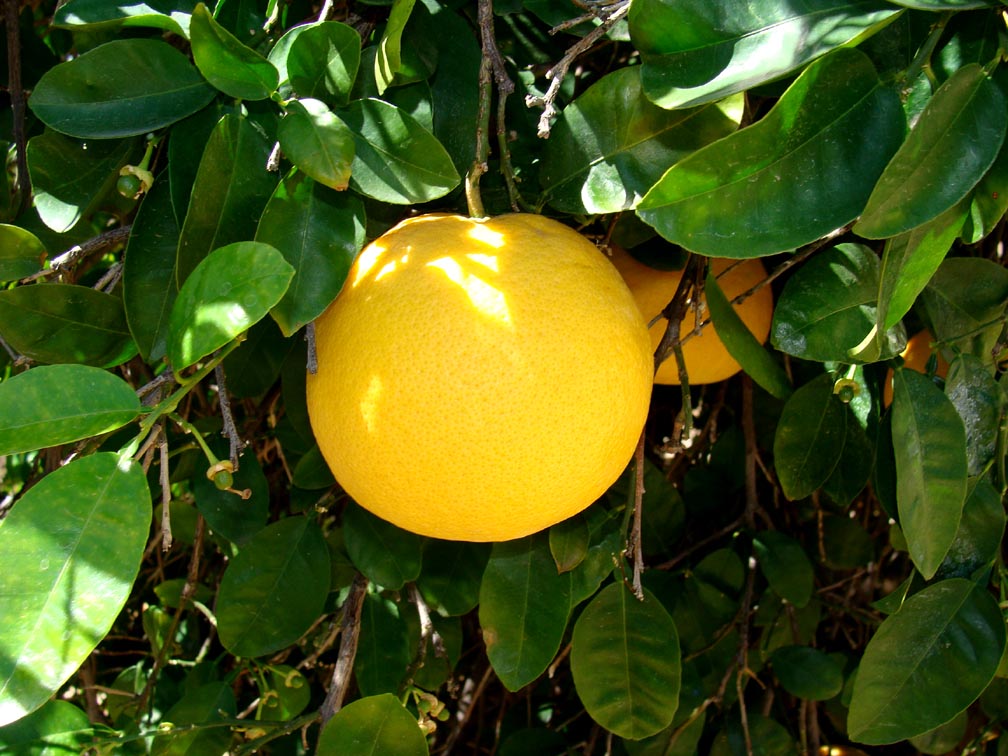
Scientific: Citrus x paradisi
Common: grapefruit, toronja
Family: Rutaceae
Origin: Originally thought to be a spontaneous sport of the pomelo, grapefruit is now believed to be an accidental hybrid between sweet orange (Citrus sinensis) and pomelo (Ctrus maxima). Interestingly, sweet orange is also believed to be a hybrid between pomelo and mandarin orange (Citrus reticulata). Grapefruit are now grown in warm desert climates around the world.
Pronounciation: CI-trus x pair-a-DEE-see
Hardiness zones
Sunset 13-24
USDA 9-11
Landscape Use: Residential fruit bearing tree, background, screen for mesic green landscape designs.
Form & Character: Rounded, clean, formal.
Growth Habit: Evergreen, woody, broadleaf perennial small tree, moderate growth rate to 15- to 30-feet tall with equal spread age, has a rounded top of spreading branches; the trunk DBH (diameter or width at breast height) of mature specimens can exceed 24-inches wide.
Foliage/Texture: Foliage is ovate, simple entire, to 4-inches long with an obvious central mid-vein, green with a winged petiole, often with stem thorns; medium coarse texture.
Flowers & Fruits: White, small, axillary 4-petaled flowers, highly fragrant; fruits are a hesperidium, round or oblate to slightly pear-shaped, 4- to 6-inches wide with smooth, finely dotted peel, usually 3/8-inch thick, multicarpulate mesoderm either a pale-lemon, sometimes blushed with pink, and aromatic, slightly bitter.
Seasonal Color: Flowers in February, fruit ripen the following December.
Temperature: Mature trees are cold hardy to 25oF. Above 110oF leaves will yellow and unpainted trunks will scald if exposed to direct sunlight.
Light: Full sun
Soil: Grapefruit need well-drained soils with a modicum of added organic matter for nutrient retention. Trees growing in alkaline desert soils need a regular fertilizer program consisting of a complete and balanced fertilizer containing micronutrients, especially zinc, iron and mangenese. Apply during January before bloom, in May after fruit abortion, and again in September to finish fruit sizing.
Watering: In desert locations, irrigate citrus regularly especially during summer. Water much less frequntly during winter.
Pruning: None, except to lightly head back branches as needed. Allow the foliar canopy to extend to the ground so that a thick arrayment of leaves can protect sensitive trunks from sunscald damage.
Propagation: Mostly grafted or budded onto regionally adapted rootstock. Rarely grown from seed or propagated by stem cutting.
Disease and Pests: There are several diseases that attack citrus in Arizona. Citrus greening is a serious bacterial disease vectored by two psyllid insects.
Additional comments: Grapefruit trees prosper in warm, subtropical and arid climates. There are several grapefruit cultivars that are ideal for growth in Arizona. Lower trunks of all citrus in Arizona including grapefruit will benefit (increased albedo = lowered surface temperatures) from having their trunks and large branches painted with a 50%/50% mixture of white latex paint and water.
A biomedical note: Secondary compounds in grapefruit peel have outstanding antioxidant activity which can be used as agents in several therapeutic strategies such as cancer prevention, and has the unsettling characteristic of increasing the efficacy of certain medicinal drugs that are taken orally.