Scientific: Cordia boissieri
Common: Texas olive, Mexican olive anacahuita
Family: Boraginaceae
Origin: The Lower Rio Grande Valley of south Texas into Mexico (Nuevo
Leon, San Luis Potosi, Coahuila and Tamaulipas)
Pronounciation: CORE-dee-a bo-si-SEAR-i
Hardiness zones
Sunset 12-24
USDA 9 (occasionally needs protection)-11
Landscape Use: Background screen, fowering accent large shrub or small tree, appropriate for use in both oasis and xeric landscape design types.
Form & Character: Rounded and colorful. When in bloom from a distance Texas olive looks somewhat like a rounded white oleander.
Growth Habit: Eventually large, woody evergreen perennial shrub or small tree, slow growth to 20 feet (height and width) in Phoenix, somewhat taller in less torrid climates.
Foliage/Texture: Leaves olive green, scabrous on the adaxial side, ovate or oblong-ovate, to 5-inches long, margins entire to crenellate; medium texture.
Flowers & Fruits: Flowers white with yellow centers, almost 2-inches across, in terminal clusters, fruits are ovoid (rounded) fleshy drupes, persistently covered, 1/2-inch long, green then ripening to creamy white, edible but NOT tasty.
Seasonal Color: In Phoenix, Texas olive produces masses of large showy white flowers during spring with a secondary bloom period during fall after the summer monsoon.
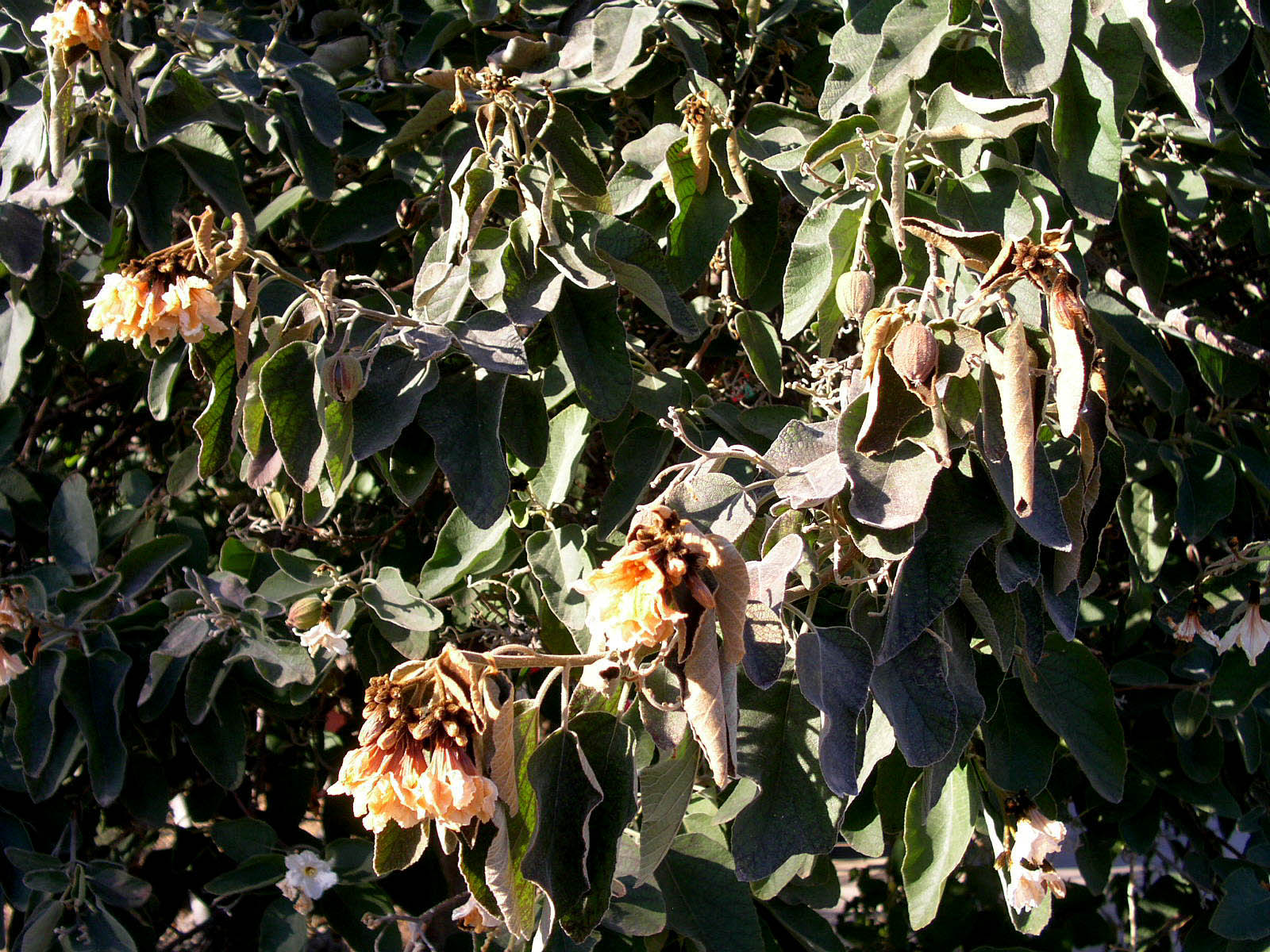
Temperature: Hardy to 25oF. Here's some stem tip injury caused by the "Great January 17th Freeze of 2007".
Light: Full sun
Soil: Well drained, but with some ability to retain nutrients (referred to as having a good cation exchange capacity).
Watering: Infrequent deep irrigations during dry times; however, more water in the summer will hasten growth.
Pruning: If cultured as a shrub, then prune infrequently and only lightly to shape. If in contrast it is cultured as a tree, then crown raise the base at a conservative pace so as to always leave a substantial canopy of foliage.
Propagation: Seed, semi hardwood cuttings.
Disease and Pests: Texas root rot
Additional comments: Texas olive is a very classy plant with very showy white
flowers that attract butterflies and hummingbirds. It does however have a short dormant period in winter during which it may look sparse. Its slow growth rate means one should plant larger specimens. First introductions of this wonderful large shrub into the Phoenix area were planted as entrance sentinel specimens at the old Baker's Nursery (now unfortunately defunct) on 40th Street north of Osborn. It is not related to the European olive (Olea europaea).
Culinary and medicinal uses: Are Texas olive fruit edible? Some say yes, some say no, and I've never tried. In certain parts of Mexico, leaves are used as a medicinal tea to treat rheumatism and bronchial congestion.
Taxonomic tidbit: Texas Olive was named after Valerius Cordus, a German botanist and pharmacist of the 16th Century and Pierre-Edmond Boissier, a 19th Century botanist.