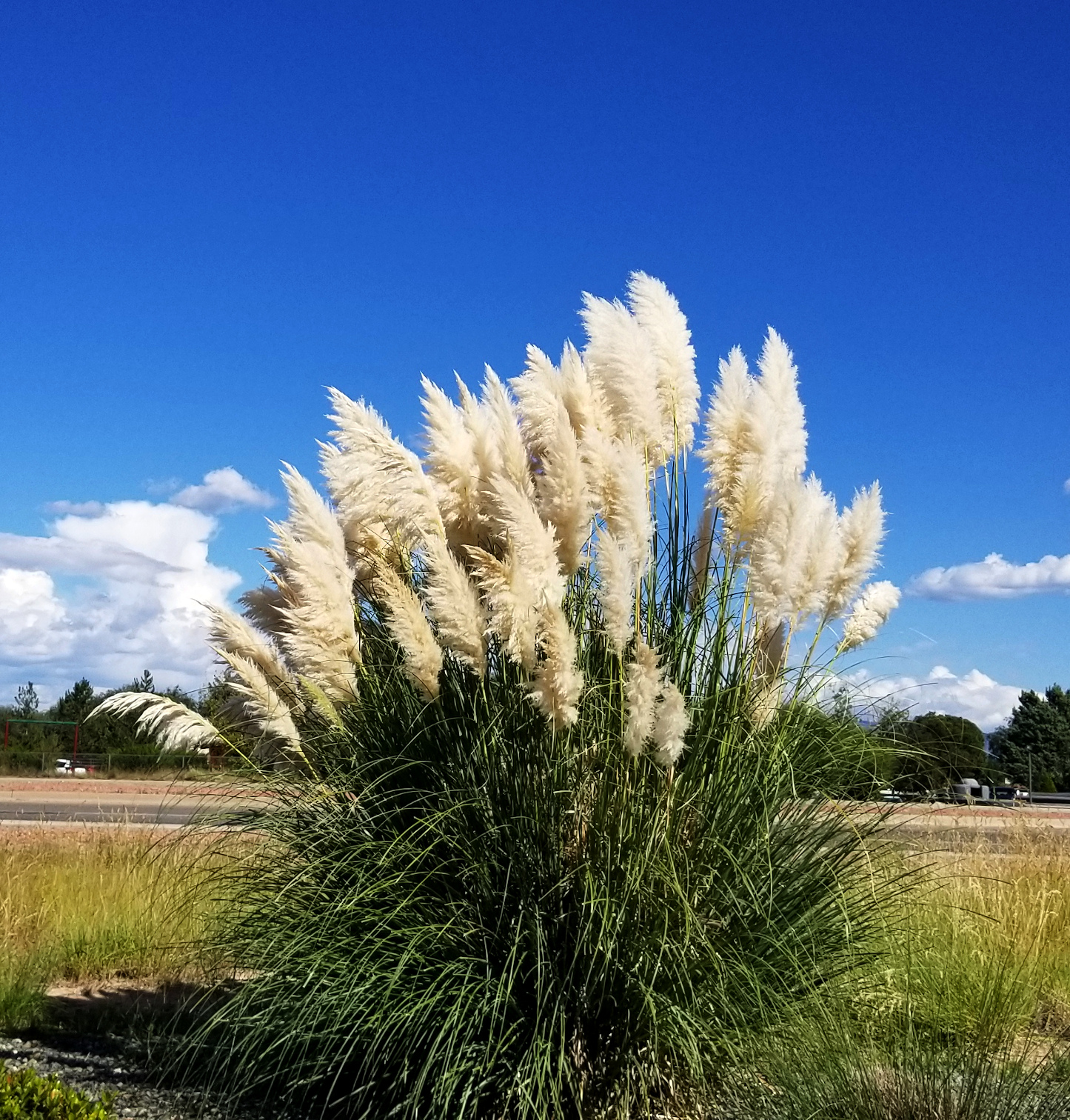
Scientific: Cortaderia selloana
Common: pampas grass, Uruguayan pampasgrass
Family: Poaceae
Origin: Temperate grasslands of South America - Argentina, Brazil, Chile and Uruguay.
Invasive alert: Pampas grass is invasive and has naturalized across the western United States in disturbed urban sites with limited supplemental moisture, especially in western California and Oregon. It also has established itself quite vigorously in New Zealand and Australia.
Pronounciation: Cor-ta-DER-e-a sel-lo-A-na
Hardiness zones
Sunset 12-24
USDA 8-11
Landscape Use: Seascape, soil stabilization, background, floral accent
Form & Character: Large (except dwarf cultivar which are slightly more bunched), robust, upright, wispy with a spectacularly pompous and regal flower display.
Growth Habit: Evergreen, herbaceous tussock perennial C4 bunch grass, moderate growth rate up to 8 feet in height with equal spread; flowering stalks can approach 20-feet tall.
Foliage/Texture: Long linear leaves are blade like, slightly glaucous, reflexed, tips narrowly tapering, bristle-like, blade often v-shaped in cross section, margins rough, stiffly and finely serrated, DANGEROUS; leaves mostly basal to two-thirds of the height of the flowing stalks. Oh yeah, the plant has a fine texture.
Flowers & Fruits: Pampas grass inflorescence is borne on a long stalk. Panicled flowers are silvery or creamy white to pink or mauve, feathery to 2- to 3-feet long. Stalks are 10 to 15 feet in height. Fruits are white, persistent on the stalk.
Seasonal Color: Dense array of flower stalks, late summer through fall.
Temperature: Cold tolerant and somewhat heat tolerant. High summer temperatures in Phoenix cause premature leaf senescence.
Light: Full sun to partial shade.
Soil: Tolerant of almost any soil condition; VERY salt tolerant.
Watering: Needs only limited supplemental water
Pruning: Hmmm....the very best way to rejuvenate and control this plant is to burn it to the ground every 2 to 3 years. Be sure to check with your local fire department before doing this because of the highly regulated world that we now live in and the tendency for tenderfoot urban folks to freak out over what otherwise is a sound, ecologically-based management practice. Otherwise, if the 'powers that be' threaten fines or jail time over an action that makes too much environmental or ecological sense, you'll have to resort to pruning your big clumps of pampas grass severely to near ground level. In the process of pruning pampas grass, be VERY careful by wearing double gloves so as to not get major, deep paper cuts. After pruning, you'll have to load the mega-mass of fibrous debris into your local dumpster so it can be taken off to help fill up our local landfills. Pampas grass trimmings DO NOT biodegrade into compost.
Propagation: A prolific seed producer, propagates easily by seed.
Disease and Pests: None, never.
Additional comments: Because of the difficulties of maintaining this large bunch grass plant, make sure that it has sufficient space in which to grow. Don't overcrowd! Pampas grass accumulates large amounts of flammable thatch (dead biomass). I've observed that pampas grass struggles a bit in Phoenix because of the summer heat. It performs far better in the mid-elevation Arizona cities and towns of Prescott, Chino Valley, Sierra Vista, Benson, Miami-Globe, Cottonwood, Sedona, Payson, Page, Ash Fork, Seligman, Kingman, Nogales, and even Tucson.
There are many named cultivars such as: