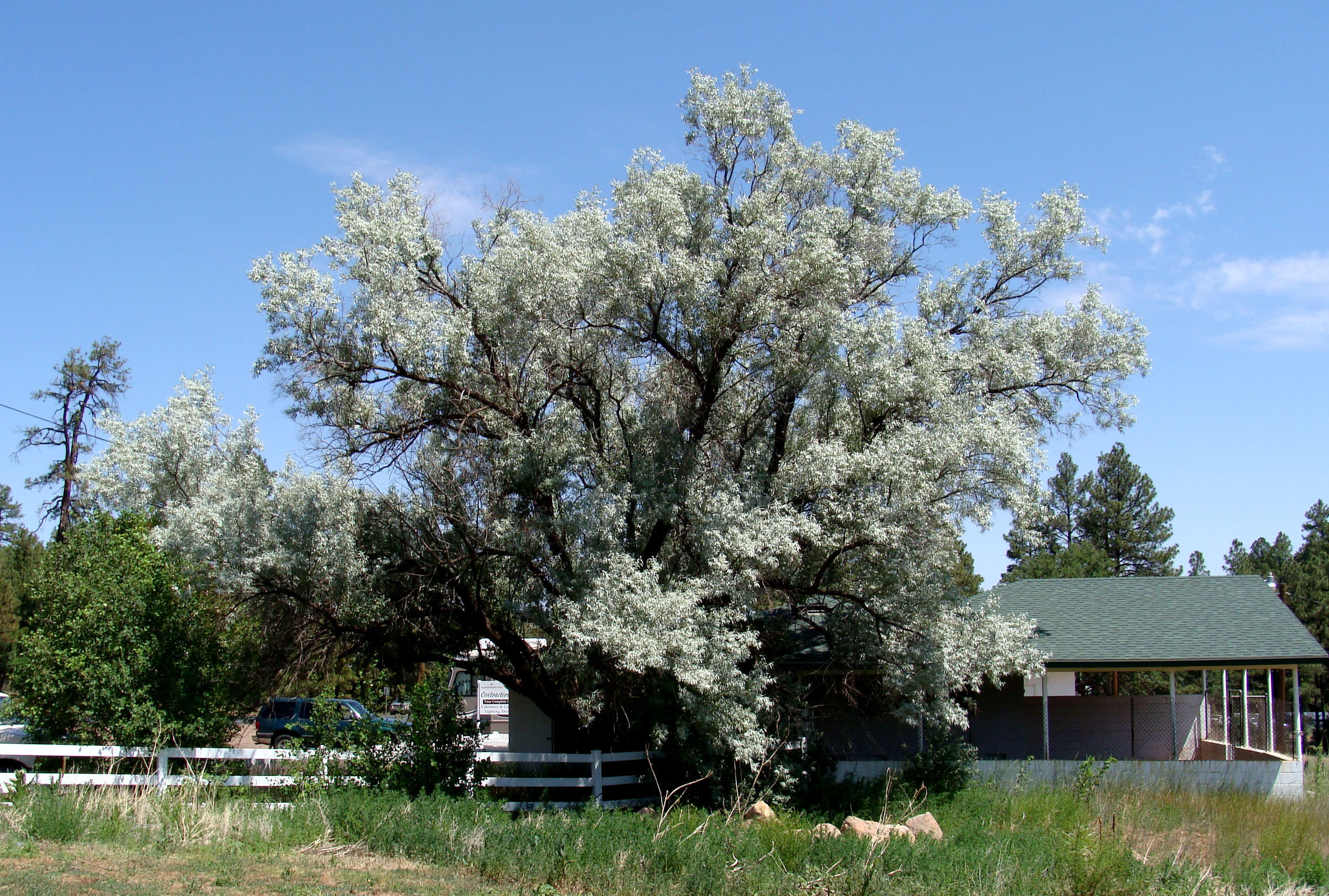
Scientific: Elaeagnus augustifolia
Common: Russian olive, Russian silverberry
Family: Elaeagnaceae
Origin: western and central Asia, from southern Russia and Kazakhstan to Turkey and Iran.
Invasive Alert: Like its close relative autumn olive (Elaeagnus umbellata), Russian olive is considered to be a very oppotunistic to invasive tree. It has naturalized in riparians areas throughout Canada and the entire USA (except the southeastern states because of the warmer, humid climate).
Pronounciation: El-ee-AG-nus a-gus-ti-FO-lee-a
Hardiness zones
Sunset 1-24
USDA 1-11
Landscape Use: Large accent tree, background, windbreak.
Form & Character: Wide open, upright spreading, carefree, silver blue.
Growth Habit: Deciduous, woody, broadleaf perennial large shrub to tree, rapid growth to 10 to 40 feet in height with greater spread. Ultimate size depends on water availability.
Foliage/Texture: Lanceolate, highly glaucous (silver blue) leaves to 6 inches in length, black bark, young stems produce thorns; medium fine texture.
Flowers & Fruits: Creamy yellow, 4-petalled flowers with a significant yellow corolla, highly aromatic, produced in clusters of 1 to 3, fruits in clusters, small cherry-like drupe, orange-brown covered in silvery scales.
Seasonal Color: Flowers in early summer, fruit in fall.
Temperature: Very cold tolerant, heat tolerant to 110oF; thus, rare to find Russian olive in Phoenix. Rather, its occurrence is mostly restricted to elevations in Arizona above 3,500 feet.
Light: Full shade
Soil: Highly tolerant
Watering: In upper elevations of Arizona where it is primarily grown, it requires supplemental water in only the most arid regions at that altitude such as the northeast Arizona desert plateau region.
Pruning: Elevate canopy base and train crown branch architecture as desired.
Propagation: Seed, softwood cuttings.
Disease and Pests: Trunk and and root heart rot can afflict older trees.
Additional comments: On balance, Russian olive is a hardy, small, and excellent tree for those desolate, high desert, landscaped areas such as the Wahweap campground at Lake Powell, Arizona, where few trees can grow and provide shade to dehydrated and sun-pruned campers. The fruit are edible, sweet, but somewhat mealy. Fruits are vigorously eaten and disseminated by many species of birds. Russian olive is a nitrogen fixer.