Scientific: Encelia farinosa
Common: brittle bush
Family: Asteraceae
Origin: Disturbed sites and sloping terrain of southwestern United States (California, Arizona, Utah, and Nevada) and northern Mexico (Baja California, Baja California Sur, Sonora, Sinaloa, and Hidalgo).
Pronounciation: En-SILL-ee-a fair-i-NO-sa
Hardiness zones:
Landscape Use: Flowering accent, foundation, native plantings, desert restoration projects, desert flower gardens.
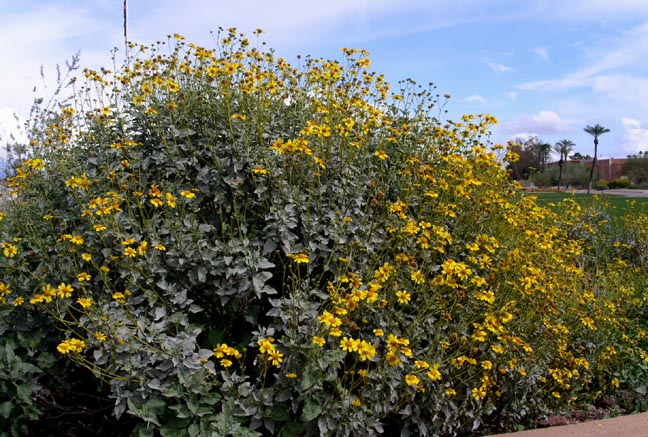
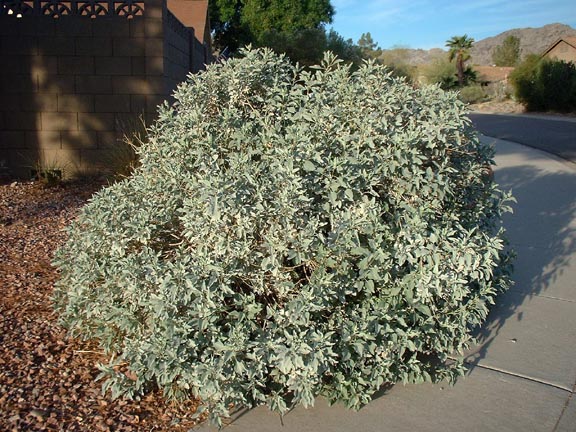
Form & Character: Rounded, dome-like to spreading, brittle, dry, wild, gray and a bit recessive, invites the desert and encourages desert dwelling.
Growth Habit: Winter evergreen to almost summer deciduous, mostly herbaceous, broadleaf perennial shrub, vigor and size higly dependent on water availability, can reach 4- to 5-feet tall, most vigorous during winter, quiescence in summer, might dieback to ground during mid summer if no irrigation is provided, opportunistic.
Foliage/Texture: Tomentose, gray green or silvery to nearly white, ovate to deltoid-shaped leaves, 2- to 3-inches long, leaf surface trichome frequency higher in summer and lower in winter; ergo, leaf appearance ranges from larger and greener in winter to smaller and whiter in summer; medium texture.
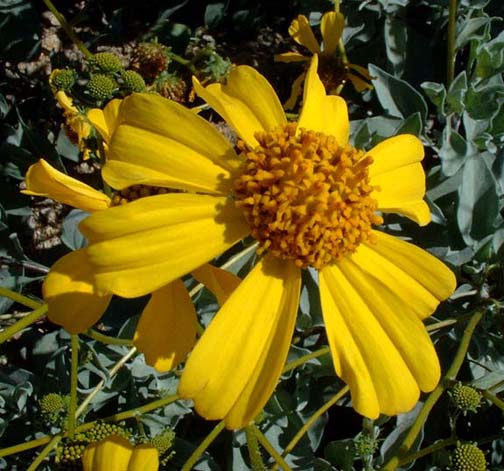
Flowers & Fruits: Yellow ray flowers to about 1-inch across in cymes, involucres (whorl of bracts around or beneath inflorescence), slightly pubescent borne in mass on terminal clusters, fruit inconspicuous.
Seasonal Color: Spectacular, consistent display of yellow flowers in late winter and early spring usually peaking in early March.
Temperature: Tolerant
Light: Full sun
Soil: Well drained
Watering: Little to none.
Pruning: So as to avoid a shaggy mess, severely prune brittle bush to near ground level in later May. Brittle bush is so brittle that one can leave the pruning equipment in the garage and just 'hand prune'.
Propagation: Easy by seed if a cold stratification treatment is given. In the Arizona desert, brittlebush seeds typically germinate either during mid-winter or mid-summer during years of plentiful winter or monsoon rains. Brittlebush germinated in mass in late October 2018 in response to the record setting rainfall that occurred in Arizona earlier that month. Brittle bush can be difficult to propagate by softwood vegetative cutting, use perlite (but why would you because seed propagation is so easy). Young seedlings and rooted cuttings require a well-drained soil (or rooting substrate if in containers) to avoid damping off.
Disease and Pests: Root rot if poorly drained soil.
Additional comments: Brittle bush works well in the landscape as an
accent companion plant to red-bird of paradise, Baja ruellia, or autumn
sage. A note of warning however is that brittle bush will quickly naturalize in Phoenix landscapes that are dominated with decomposing granite and open space. Flower stamens exude a fragrant resin that was used by Spanish padres as an incense, leaves and stems used by native Americans as a tea for arthritis.
Taxonomic musings: The genus Encelia is comprised of some 15 species from southwestern North America and western South America. All the North American species are obligate outcrossers (they hybridize to produce fertile F1 offpsring). There are two recognized naturally-occurring varieties, Encelia farinosa var. farinosa (yellow disc florets) and Encelia farinosa var. phenicodonta (purple-brown disc florets). Encelia californica [shown here growing along the Pacific coast highway (PCH) near the Topanga Canyon turnoff] is a comparable green-leaved species found along the coastal areas of California and Baja California.
Ethnobotanical uses: Brittlebush has a history of uses by indigenous and pioneer peoples, including:
Sunset 11-13
USDA 9-11 (arid regions only)