Scientific: Eriobotrya japonica
Common: loquat
Family: Rosaceae
Origin: Native to southeastern China and possibly southern Japan,
though it may have been introduced into Japan about 1000 years ago. Loquat has naturalized
in India.
Pronounciation: Er-i-bo-TRY-a ja-PON-i-ca
Hardiness zones
Sunset 12-24
USDA 7-11
Landscape Use: Edible fruit crop, screen background large shrub for mesic and oasis landscape gardens in the Phoenix area.
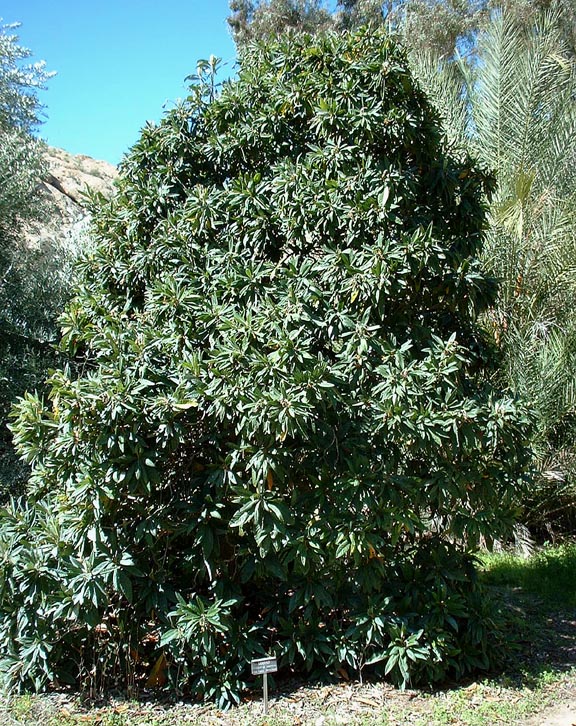
Form & Character: Upright large shrub to small tree depending on how it is trained, imposing, full, dense, mesic, formal, evokes a sense of 'garden'.
Growth Habit: Evergreen, woody, broadleaf perennial large shrub to small tree, moderate growth rate eventually reaching 15 to 20 feet (taller in climates with less extreme heat) with a somewhat lesser spread, dense canopy.
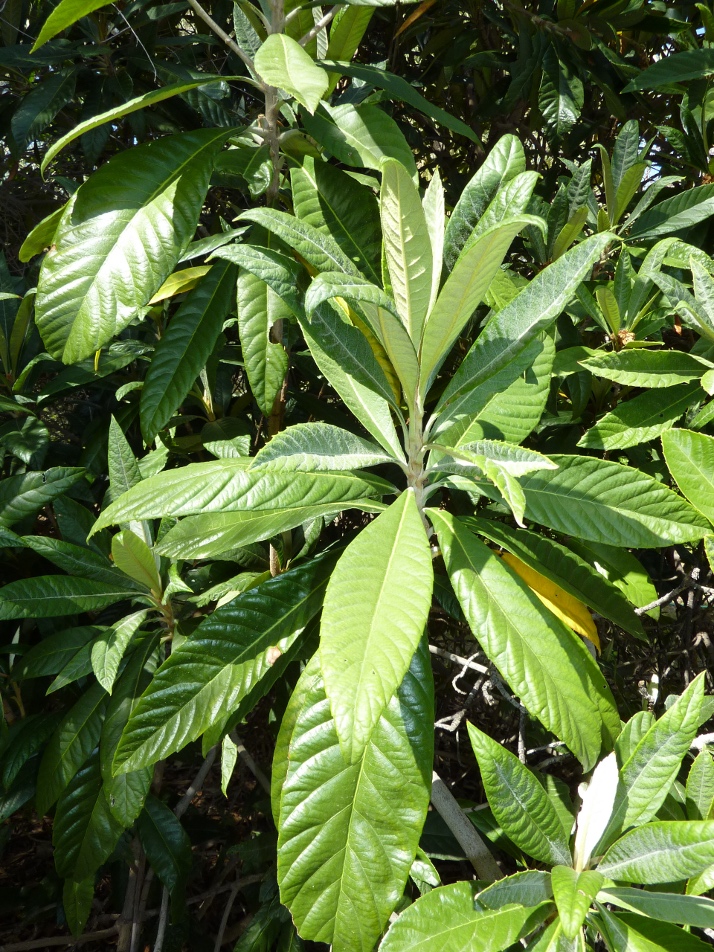
Foliage/Texture: Leaves mostly whorled at the branch tips, elliptical-lanceolate to obovate lanceolate, 5- to 12-inches long and 3- to 4-inches wide; dark-green and glossy on the upper surface, whitish-or rusty-hairy beneath, thick, stiff, with conspicuous parallel, oblique veins, each usually terminating at the margin in a short, prickly point, coarsely serrate; coarse texture.
Flowers & Fruits: Fragrant flowers, borne in rusty-hairy, terminal
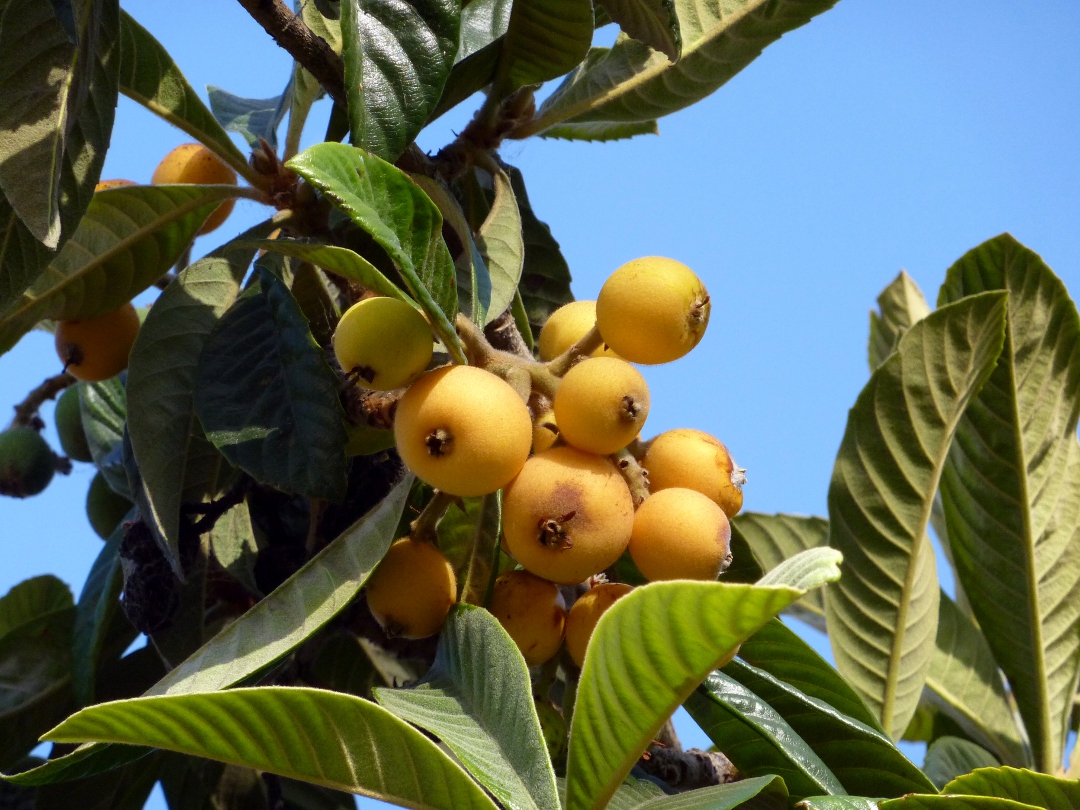
panicles of 30 to 100 blooms, white, 5-petalled, 1/2 to 3/4 inch in width. Fruits, in
clusters of 4 to 30, oval, rounded or pear-shaped, 1 to 2 inches long, with smooth
or downy, yellow to orange, sometimes red-blushed, exoderm and white, yellow or
orange, succulent, edible mesoderm. Fruit mesoderm has a sweet to sub-acid or acid flavor
(mucho tasty!!). Fruit contain 1 to 10 small seeds (normally 3 to 5), brown,
angular-ellipsoid.
Toxicology note: Loquat seeds contain the chemical cyanogenic glycoside which can be poisonous if eaten in
significant quantities, especially by children.
Seasonal Color: None
Temperature: Cold hardy to 15oF once established, but heat
sensitive. Sunburn, called "purple spot", is responsible for much fruit loss in
hot regions with long summers.
Light: Full sun to partial shade.
Soil: Salt and alkaline soil sensitive, needs good drainage, prefers a
rich organic amended soil.
Watering: Regular irrigations are needed throughout the year.
Pruning: Little to none required, and in Phoenix pruning is discouraged
as loquat are prone to trunk sunscald. The thinning of flowers and young
fruits in the cluster, or the clipping off of the tip of the cluster, or of
entire clusters of flowers and fruits, can be done to enhance fruit size.
Propagation: Seed (remain viable for 6 months if stored in partly
sealed glass jars under high humidity at room temperature, but the best
temperature for storage is 40oF) or vegetative softwood cuttings (difficult to root). Cleft and
veneer grafting techniques have been used successfully in Florida and Pakistan, respectively, in commercial operations. Air-layering is successful if treated with 3% NAA (2-naphthoxyacetic acid) solution.
Disease and pests: Bacillus amylovorus, Phytophthora,
and Pseudomonas eriobotryae, and Erwinia are problems in
California; however these diseases on loquat are not common in Arizona because
of the drier climate.
Additional comments: Many will classify loquat as a small tree; however, I think of it as functionally a large
shrub because in Phoenix it is necessary to allow the foliar canopies of loquat
plants to extend to the ground to prevent trunk sunscald damage. There are over 800 varietal selections of loquat worldwide and loquat is a plant of many uses.
The many uses of loquat: Loquat fruits can act as a sedative and flowers have expectorant properties. An infusion of dried or powdered leaves may be taken to relieve diarrhea, depression, depression from too much diarrhea, or to counteract
intoxication from consumption of alcoholic beverages (Note: I have not personally confirmed the veracity of these medicinal benefits). Loquat is one of the most popular cough remedies in the Far East and is an ingredient of many patented cough medicines. There are many online recipes for loquat jams, pies, etc.