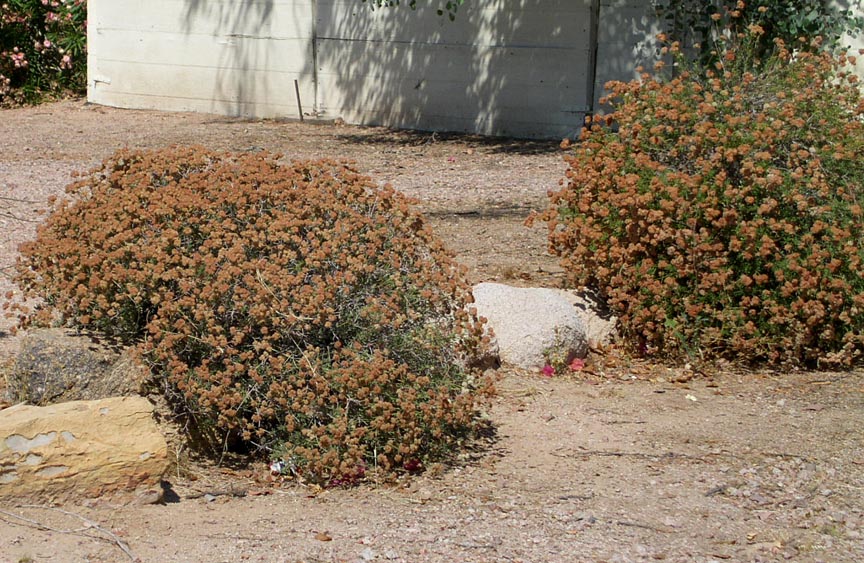
Scientific: Eriogonum fasciculatum (several accepted synonyms including Eriogonum fasciculatum foliolosum)
Common: California buckwheat, eastern Mojave buckwheat, eastern Mojave wild buckwheat, flattop buckwheat, yellow buckwheat
Family: Polygonaceae
Origin: Commonly found on rocky south facing slopes of the Mojave,
Sonoran, and Chihuahuan deserts at elevations ranging from 1000 to 4500 feet.
Variety foliolosum (California buckwheat) is found in California chaparral communities.
Pronounciation: Er-i-o-GO-num fas-ci-cu-LA-tum
Hardiness zones
Sunset 11-24
USDA 7-11
Landscape Use: Upland desert native water conservation gardens, rock gardens, subtle flowering accent, filler plant, restoration plantings.
Form & Character: Informal, low rounded and dense, subshrub like, arid, desert chaparral.
Growth Habit: Evergreen, woody, narrowleaf perennial shrub, moderate to slow grower, 1- to 6-feet tall with a spread of 3 to 8 feet; mostly on the smaller side of this description when grown in Phoenix.
Foliage/Texture: Leaves are linear, sometimes lobed at terminal ends, gray-green, to 3/4-inch long and curved or rolled inward. Adaxial (upper) leaf surface is dark green and viscid (sticky); abaxial (lower) leaf surface is highly tomentose; fine texture.
Flowers & Fruits: Terminal, pinkish white blooms occur over a long period on 2- to 5-inch long stalks, usually March-November in the wild. Blooming season is truncated to spring in lower desert landscapes because of the heat; fruit inconspicuous, a fruit is considered ripe when when the spent flower base enclosing it has turned light brown or rusty brown.
Seasonal Color: White to rosy pink fading to a pinkish brown nearly year around.
Temperature: Tolerant
Light: Full sun
Soil: Tolerant of soil alkalinity, needs well drained soil.
Watering: Needs only infrequent and modest water during the summer in lower desert urban areas. Supplement water for better ornamental quality.
Pruning: Lightly head back buckwheat once every few years to thicken canopy cover and control shape. Otherwise, please leave them alone and enjoy their special contribution to your desert garden.
Propagation: Seed and softwood cuttings
Disease and Pests: Root rot pathogens in chronically wet or poorly-drained soil.
Additional comments: Buckwheats are a rarely used southwestern native perennial shrub. In my opinion, buckwheats are deserving of greater attention and landscape use for native plantings and landscape water conservation. The variety poliofolium is a small, dwarf selection with especially showy, pinkish-white flowers. Buckwheat shrubs are important pollinator plants for native bees.
Eriogonum fasciculatum var. polifolium is a desert varietal selection that is especially well-suited for Phoenix desert landscapes.