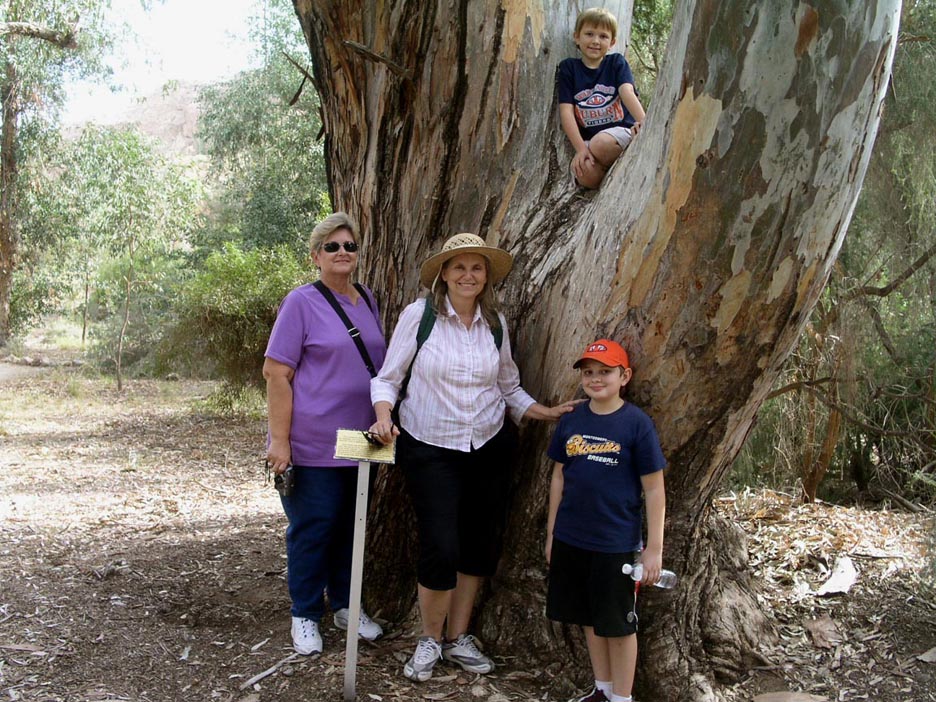
Scientific: Eucalyptus camaldulensis (there are two other recognized varieties: var. obtusa and var. simulata)
Common: red gum, Murray red gum
Family: Myrtaceae
Origin: Broad range encompassing all mainland states of Australia. This is said to be the most widely distributed eucalypt, ranging over 23 degrees of latitude in most of arid and semiarid Australia, but not the humid eastern and southwestern coasts. It is regarded as one of the most widely planted eucalypts in the world. Plantations occur in North and South America, Africa, and Asia.
Pronounciation: Ewe-ka-LIP-tus ca-mal-du-LEN-sis
Hardiness zones
Sunset 10-24
USDA 9-11
Landscape Use: Highway plantings, strong silhouette and/or skyline feature, large park tree.
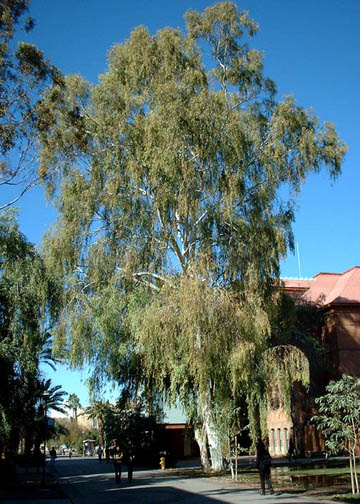
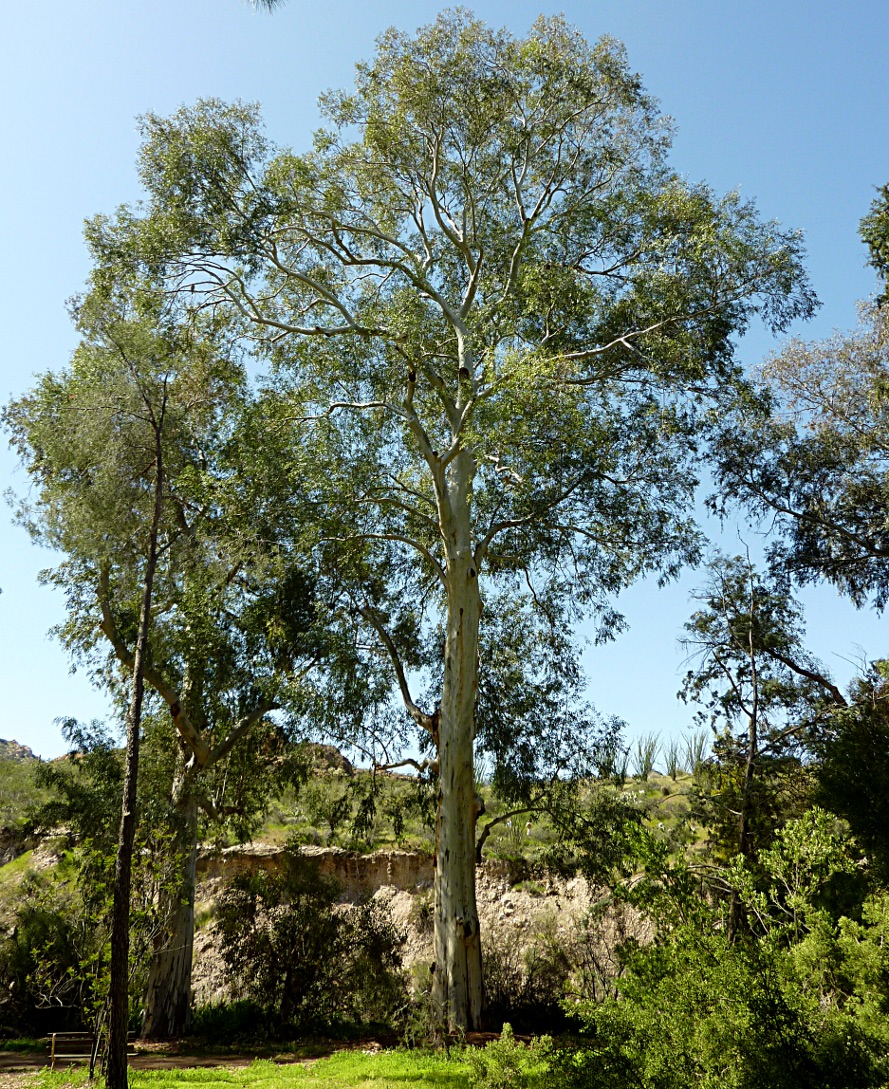
Form & Character: This is a massive tree that is rugged and stout, strong appearance, young stems pendulous, heavy, ominous, and imposing.
Growth Habit: Evergreen, woody, broadleaf perennial tree, upright and vigorous to 120 feet in height. Trunk and large branches are bodaciously girthy.
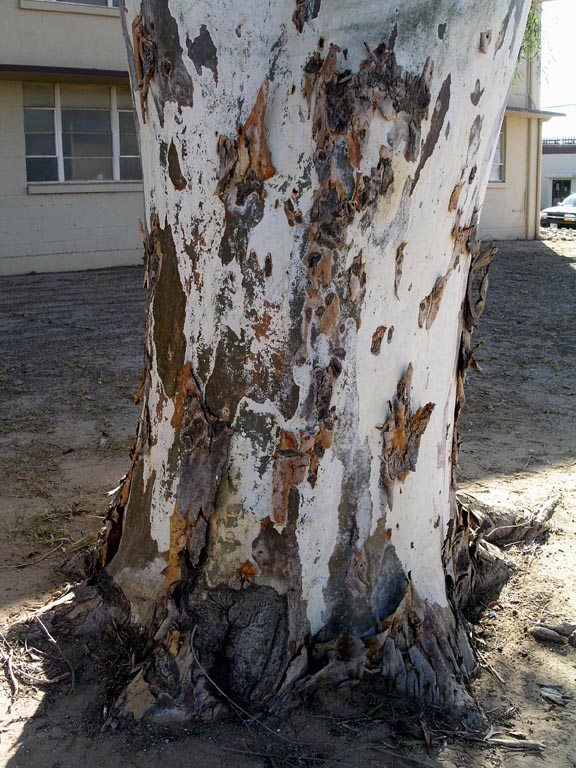
Foliage/Texture: Leaves alternate, gray-green and lanceolate with acuminate tip, trunk has deciduous bark which sheds to reveal smooth light gray to white trunk with streaks and blotches of cinnamon red; medium coarse texture.
Flowers & Fruits: Small, 1/2 inch, white to pale yellow flowers in umbellate clusters of 5 to 10; summer fruits are pediculate, hemispherical to 5/16-inch across, valves are exerted.
Seasonal Color: None
Temperature: Hardy to about 10oF.
Light: Full sun
Soil: Tolerates some alkaline soils, but Murray red gum in the Phoenix area will develop a general chlorosis if soil is both alkaline and chronically wet such as near turf grass.
Watering: Moderately drought tolerant, but usually needs some summer water.
Pruning: Elevation of canopy base, because of pendulous growth habit, crown thinning may also be needed.
Propagation: Seed
Disease and Pests: Mysterious summer yellowing and branch dieback in the Phoenix area might be caused by an environmental interaction of soil alkalinity with high summer nighttime temperatures. Also susceptible to Phytophthora and Texas root rots.
Additional comments: Red gum is not recommended for use around schools or other areas that are frequented regularly by people because limb drop (big one's) sometimes occurs without warning. Red Gum was once widely planted in the Phoenix area, but is rarely planted as a landscape tree today. Highly prone to root deformation if grown in containers because of its rapid growth rate.
Medicinal folklore: Murray red gum is reported to be anesthetic, antiseptic, and astringent. It is a folk remedy for colds, colic, coughs, diarrhea, dysentery, hemorrhage, laryngalgia, laryngitis, pharyngitis, sore throat, spasm, trachalgia, and wounds. The oils from eucalyptus leaves are highly flammable!
Travel tip: For a real local kick, visit the Boyce Thompson Arboretum in Superior, AZ and get your picture taken standing next to Mr. Big, planted in the 1920s by mining magnate Col. William Boyce Thompson.