Scientific: Eucalyptus spathulata
Common: narrow-leaf gimlet, swamp mallet, swamp gimlet
Family: Myrtaceae
Origin: Rare tree, endemic to select areas across south Australia.
Pronounciation: Ewe-ka-LIP-tus spath-u-LA-ta
Hardiness zones:
Sunset 8-24
USDA 9-11 (arid and semi arid regions best)
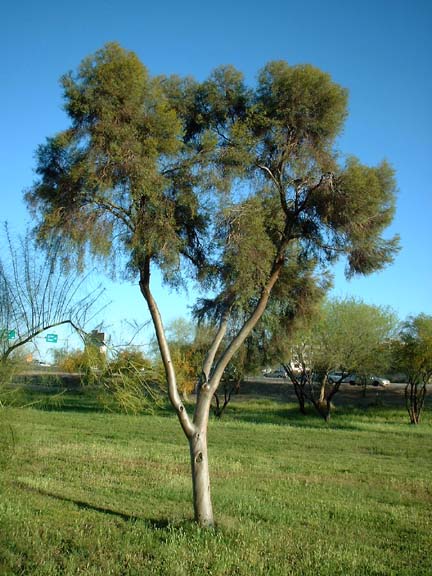
Landscape Use: Small to medium-sized, open-canopied tree that casts a light shade, a great residential or patio tree, excellent for nightime uplighting of smooth trunk character, background, screen
Form & Character: Sleek (smooth bronzy brown trunk) and sassy - a refined evergreen small tree with an endearing rounded habit with age.
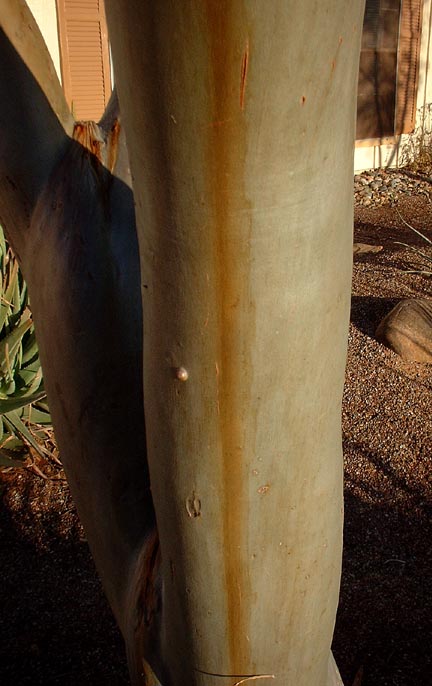
Growth Habit: Evergreen, woody, 'broadleaf' (actually quite narrow) perennial tree, moderate and open to 20 to 30 feet with somewhat less than equal spread, often multi-trunk. Trunk always smooth, Grayish cinnamon brown in color shedding a single layer in early summer to become bronze metallic in color.
Foliage/Texture: Foliage is nearly linear, not falcate, to 3-inches long, gray green sometimes tinged with red when immature. Like many eucalypts, the trunk of narrow-leaf gimlet sheds a single layer during early summer like a snake sheds it skin; very fine texture.
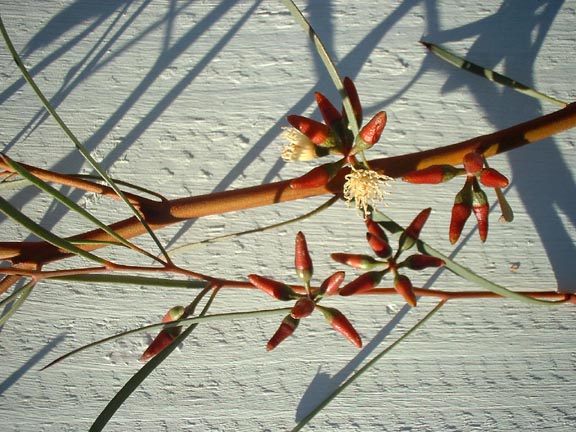
Flowers & Fruits: Small golden cream white to pink to red flowers in terminal conflorescent (clustered) in groupings of 3 to 7, flower peduncles are narrowly flattened or angular; fruits are very small capsules, less than 1-inch wide, hemispherical with exserted valves.
Seasonal Color: Very, very subtle floral display in spring and fall. New foliage is reddish.
Temperature: Tolerant, cold hardy to 15o to 20oF and heat tolerant to 118oF.
Sad note of obituary: The ridiculous, hellacious summer heat of 2020 killed many a narrow-leaf gimlet trees across the Phoenix metro area.
Light: Full sun
Soil: Tolerant, suitable for extreme saline sites (ECe 8.0-16.0 dS/m).
Watering: Moderately drought tolerant. Excessive water encourages growth of weak wood.
Pruning: Elevate canopy base to expose trunk character. Use thinning cuts when the tree is young to establish a strong scaffold branch system.
Propagation: Seed, reported to germinate easily when seed are fresh.
Disease and Pests: Narrow-leaf gimlet is susceptible to bacterial wet wood that is typically spread through use of unsterilized pruning equipment.
Additional comments: Once established, narrow-leaf gimlet is potentially one of the best small eucalyptus for Phoenix residential landscapes. Be sure to screen nursery stock for upright forms with a straight and sturdy trunk and smaller adult leaves. Otherwise, be sure to train young trees rigorously to establish a strong and well balanced scaffold branch system. If not trained, this small tree will
show 'malle' (shrub) characteristics which may be sufficient when used as a very large background screening plant. The wood of narrow leaf gimlet is not as dense as other eucalyptus, bu can be used in wood working.
Check out this really cool burl growing on a large specimen in north central Phoenix.