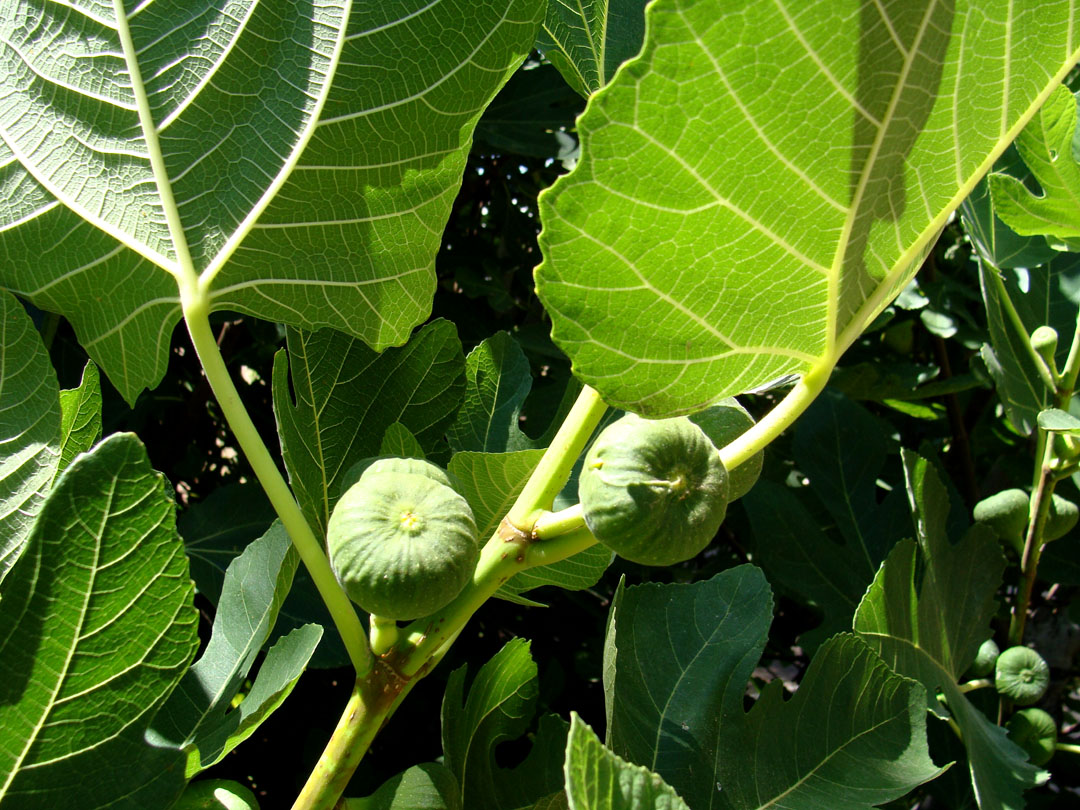
Scientific: Ficus carica
Common: common fig
Family: Moraceae
Origin: The common fig is native to western Asia, and has been cultivated for thousands of years in Mediterranean countries of Europe and North Africa. Figs were introduced to England and Mexico in the 1500's, then the Eastern US in 1669, and to California in 1881 and later Arizona.
Pronounciation: FII-cus CAR-i-ca
Hardiness zones
Sunset 4-9, 12-24
USDA 6-11
Landscape Use: Edible fruit gardens, textural accent.
Form & Character: Edible fig trees are happy with a vibrant and vigorous but squat character, spreading, a real 'grow me in your garden' tree.
Growth Habit: Deciduous, woody, broadleaf perennial tree, moderate and densely foliated to 15- to 30-feet tall with generally a greater spread.
Foliage/Texture: Alternate, simple, deciduous; 5 inches in diameter, but sometimes larger; palmately lobed with (usually) 5 finger-like lobes, lustrous, glabrous. Bark is smooth and silvery gray, somewhat warty; coarse texture.
Flowers & Fruits: The small flowers are produced twice in the season. The first ones (the breba crop) are produced near the ends of the shoots of the preceding flush of growth, whereas the second crop (the main crop) is produced in the axils of the leaves on the new growth. Borne in inverted inflorescences in axils of leaves on one year old wood (breba crop) and current season's wood as well (main crop). In cultivated "common" figs, all flowers are female, packed along the inside of the inflorescence, consisting basically of an ovary and a single style. Fruit (not technically a fruit, but a swollen stem) is a "synconium" (multiple of druplets with swollen receptacle).
Seasonal color: None
Temperature: The common fig is very hardy of desert heat and cold.
Light: Full sun
Soil: Tolerant
Watering: Regular
Pruning: Easily manipulated from light tip pruning to pollarding. Because reproductive growth occurs in "new" wood, always prune during late winter while dormant.
Propagation: Roots very easily from hardwood cuttings.
Disease and Pests: Root knot nematodes, occassional spider mites during late summer.
Additional comments: The common fig is a GREAT garden tree for the lower desert of Arizona. Figs have been an important fruit of commerce in the eastern Mediterranean region since antiquity, and today are grown in many parts of the world. Nutritionally, figs have a high sugar content and are a fair source of vitamins A and B. The milky sap or latex often exudes from cuts in stems or when fruit are harvested; this can cause dermatitis, and gloves should be worn by persons with sensitive skin.
In Phoenix, the best cultivated varieties of fig are: