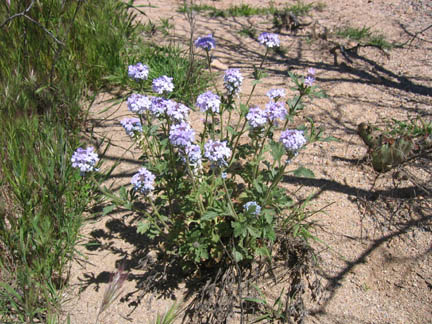
Scientific: Glandularia gooddingii (Synonym: Verbena gooddingii)
Common: Goodding verbena
Family: Verbenaceae
Origin: Arid regions of Arizona, Nevada, New Mexico,
California, Texas, and southern Utah below 5,000 feet mostly in canyon
washes, rocky slopes or grassy hillsides.
Pronounciation: Glan-du-LAR-ee-a good-DIN-gi-i
Hardiness zones
Sunset 10-13
USDA 8-11
Landscape Use: Accent and small ground cover for smaller scale xeriscape planter beds, rock and wildflower gardens, borders and walkways, and courtyard plantings, landscape mounds or poolside (avoid pool water runoff).
Form & Character: Low, somwehat diminuative, prostrate and spreading, open, delicate.
Growth Habit: Evergreen, herbaceous perennial, slow to moderate growth rate to 12- to 18-inches tall with 2 to 3 feet spread.
Foliage/Texture: Glaucous, green leaves 1- to 2-inches long and 1-inch wide, usually three clefted and coarsely serrate, stems and leaves pubescent; medium fine texture.
Flowers & Fruits: Terminal cymes like clusters of pink, light blue to magenta flowers, fruit inconspicuous.
Seasonal Color: Flowers in winter and spring.
Temperature: Tolerant of all temperature regimens above 24oF.
Light: Full sun
Soil: Well drained at must, otherwise tolerant of most soil types.
Watering: Give regular and frequent water during blooming period if winter and spring rains fail, otherwise infrequent in summer and fall.
Pruning: Severe renewal pruning in summer after bloom to rejuvenate.
Propagation: Seed, will sometimes reseed in urban landscapes.
Disease and Pests: Root rot in poorly drained soils.
Additional comments: Goodding verbena is typically a short-lived perennial that elicits a wonderful display of color during the winter and spring months. In Phoenix, the foliage typically looks ragged during summer as the plant tends to grow very little then. Usually, Goodding verbena is a good companion plant to Melampodium, Baileya, Ambrosia, or Penstemon species. It looks best if it is planted in mass at 2 feet on center in a mixed species landscape flower border. Flowers attract butterflies.