Scientific: Hesperaloe funifera
Common: giant yucca, Coahuilan hesperaloe, or Samandoque
Family: Asparagaceae (subfamily Agavoideae)
Origin: Lower elevations in the east-central part of the
Chihuahuan Desert in Coahuilla and Nuevo Leon.
Pronounciation: Hes-per-AL-oo fu-ni-FER-a
Hardiness zones:
Sunset 10-16, 18-21
USDA 8-11 (in arid and semi-arid climates only)
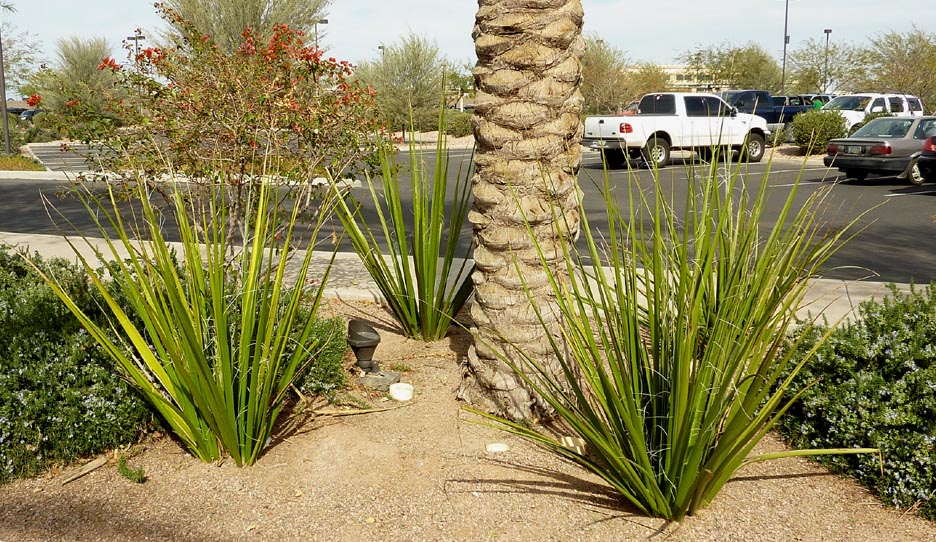
Landscape Use: Vertical accent plant for xeric landscape design themes, desert plantings as single or in groups, for large landscape spaces. Be careful when planting to give regard to the eventual large size (both actual and visual) of this desert shrub!
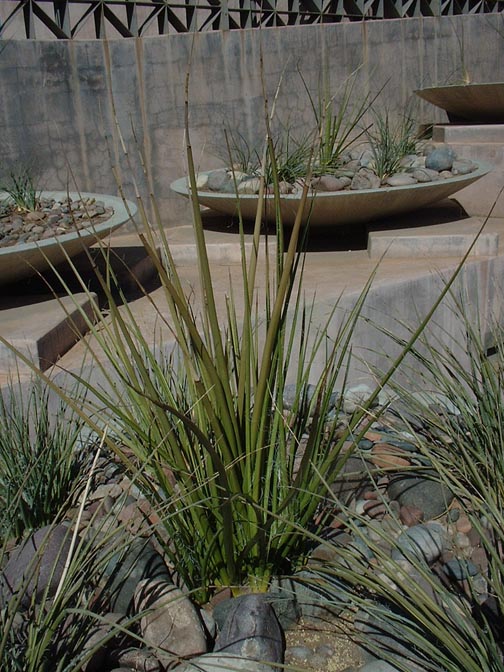
Form & Character: Agave like, linear, stiff and upright, dry, excellent xeriscape plant, informal, unconfined, needs much larger landscape spaces than its cousin, red yucca.
Growth Habit: Evergreen, non-woody, acaulescent perennial shrub, Clumping to 4 to 5 feet with candelabra flower stalks to 10 feet with a rosette habit. As in all Agavaceae, the basic module of growth is the rosette, a cluster of leaves produced from a single meristem. This meristem produces several leaves before switching from vegetative to reproductive mode. Once the flower stalk is produced, the rosette ceases to grow. With giant yucca lateral or secondary rosettes are produced from the crown after the primary rosette becomes reproductive. Although an older giant yucca plant has the appearance of a closely packed, often grass-like clump of leaves with several flower stalks, the plant actually consists of a cluster of separate but closely-spaced rosettes. The older flowering rosettes are found at the center of the clump; younger vegetative rosettes are on the periphery of the clump.
Foliage/Texture: Light green, curved, narrow, strap-like leaves to 4 feet in length with numerous white filament hairs on margins; medium coarse texture.
Flowers & Fruits: Numerous white bell shaped flowers on very long candelabra branched flower stalk, up to 10 feet in length. Fruits are a green aging to brown multiple carpulate capsule....in my opinion they are a tad on the ugly side.
Seasonal Color: White flowers in April and May.
Temperature: Highly adapted to the Sonoran desert climate.
Light: Full sun certainly required.
Soil: Fast draining, Well drained, rocky soils are best. Avoid planting in the base of landscape water catchments.
Watering: Drought tolerant, infrequent summer irrigations, more robust and faster growth with more water.
Pruning: Remove old flower stalks in June. The misplacement of giant yucca in the landscape (into small spaces with not enough room for it to grow to its mature full size) sadly opens the door for all the 'Horticultural clods of Phoenix' (aka 'hort clods') to shear this plant. The results are horrific!
Propagation: Seed or division or clumps.
Disease and Pests: None
Additional comments: Giant yucca is an excellent VERY LARGE desert shrub and is not at all recommended for smaller spaces where its arching and reaching habit of growth immediately becomes problematic. The long, thin leaf fibers of giant yucca produce a pulp that has exceptional strength properties and has been used in paper production.
Hesperaloe funifera can hybridize with Hesperaloe parviflora. Here is Hesperaloe x 'Pink Parade', a wonderful, mid-sized funifera and parviflora hybrid, which is curently sold by Mountain States Wholesale Nursery, Glendale, Arizona.
Derivational tidbit: 'Hespero' is latin for 'western'; thus Hesperaloe literally translates as 'western aloe'.