Scientific: Iris germanica
Common: bearded iris
Family: Iridaceae
Origin: Hybrid, original species from Mediterranean region
Pronounciation: I-ris ger-MAN-i-ca
Hardiness zones
Sunset All
USDA All
Landscape Use: Iris is a traditional garden border color and texture accent plant. It's also used in fragrance gardens.
Form & Character: Upright and stout, colorful, beautiful, tough, informal, yet traditional.
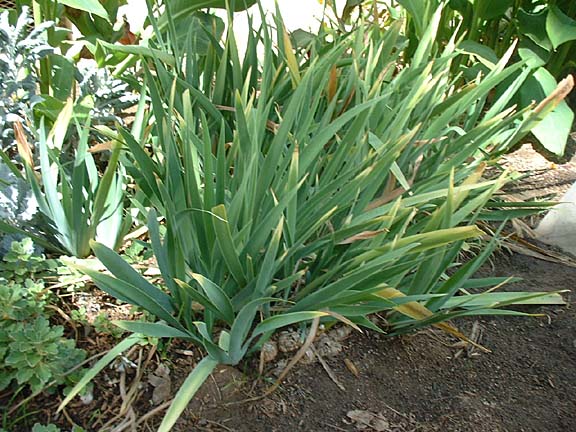
Growth Habit: Evergreen, herbaceous perennial from 18-inches to 4-feet tall, strongly clumping by horizontal branching of rhizomes just beneath the soil surface. Bearded iris plants are biologically active during most of the year, except during summer when they are quiescent to dormant depending on site exposure and water availability.
Foliage/Texture: Alternate, flat basal fans of 10 or more leaves, outermost leaves smallest, lanceolate to 18-inches long by 2-inches wide, glaucous blue; coarse texture.
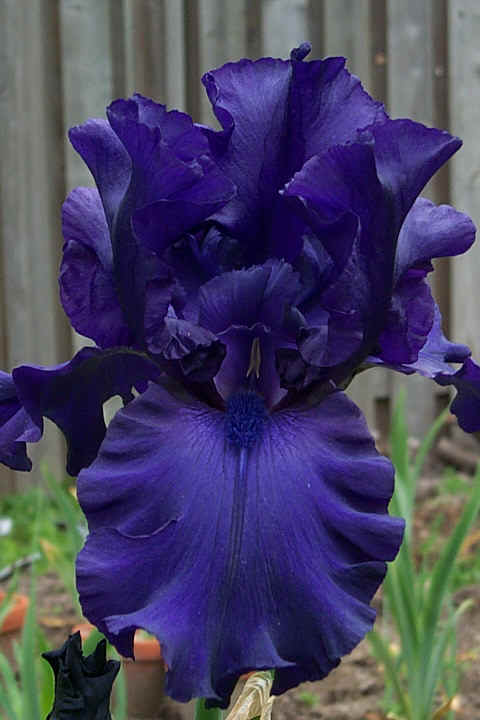
Flowers & Fruits: Flowers, 4 to 8 on a naked spike up to 4-feet tall. Spikes arise from the terminal meristem generally the second year after transplanting. Flower colors are abundant ranging from white, yellow, orange, red, maroon to blue and violet; bicolors are common too. Flowers are 6-segmented with 3 segments upright and incurved (called "standards") and 3 segments reflexed (called "falls"). The "falls" have a tuft of trichomes (hairs) at their base which is the "beard". Iris fruits are large, green, ovoid capsules.
Seasonal Color: Mostly spring flowering accent in the Phoenix area.
Temperature: Tolerant
Light: Partial to Full sun, but avoid Phoenix west exposures.
Soil: Tolerant of alkalinity and drought when not in bloom, prefers well drained.
Watering: Regularly irrigate when actively growing during cool season (if desert winter rains are sparse), otherwise irregular in summer. In Mediterranean climates such as found in southern Califonia, bearded iris mostly require no added water.
Pruning: Remove spent flower stalks and old senescing foliage.
Propagation: Division of clumps every three years for multiplication of stock and retention of plant vigor.
Disease and Pests: Whitefly, diabrotica on flowers, root rot in poorly drained soils.
Additional comments: Stately, popular, colorful herbaceous
perennial with hundreds of cultivated varieties. Sizes range from
miniatures (8- to 15-inches height) to tall bearded (4-feet height).
Taxonomic tidbits: Iris means
rainbow. There are about 300 species of Iris worldwide.
For more information: