Scientific: Lagerstroemia indica
Common: Crape myrtle
Family: Lythraceae
Origin: India, southeast Asia
Pronounciation: La-ger-stro-EM-ee-a IN-di-ca
Hardiness zones:
Sunset Treated as perennial in 1-3, excellent in 7-10,
12-14 and 18-21
USDA 6 (freeze damage likely), 7-11
Landscape Use: Accent shrub, specimen small multiple trunk tree, single tree standard (though basal suckers are a maintenance concern), entryway plantings, dwarf cultivars as container plants and landscape shrubs, mesic design themes in Phoenix only.
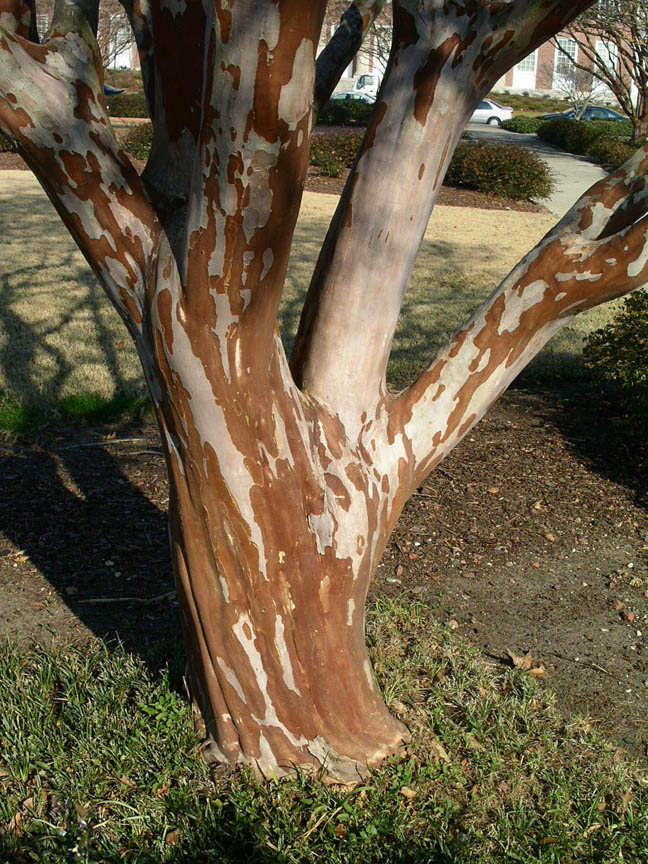
Form & Character: Generally rounded, short to upright, bright summer and fall color. Crape myrtle is typically clean in appearance during summer, but can look dead during winter despite wonderful trunk characteristics.
Growth Habit: Deciduous, woody, broadleaf perennial shrub or small tree, depending on training and landscape use. Mature size depends on cultivar growth habit. Dwarf cultivars are only as tall as 3 feet with an equal spread, whereas vigorous cultivars can grow upright as tall as 30 feet. Trunk, stems and branches are smooth.
Foliage/Texture: Oblong elliptic to rounded, reddish when young maturing to green, 2-inches long, glabrous or pubescent on veins; medium texture.
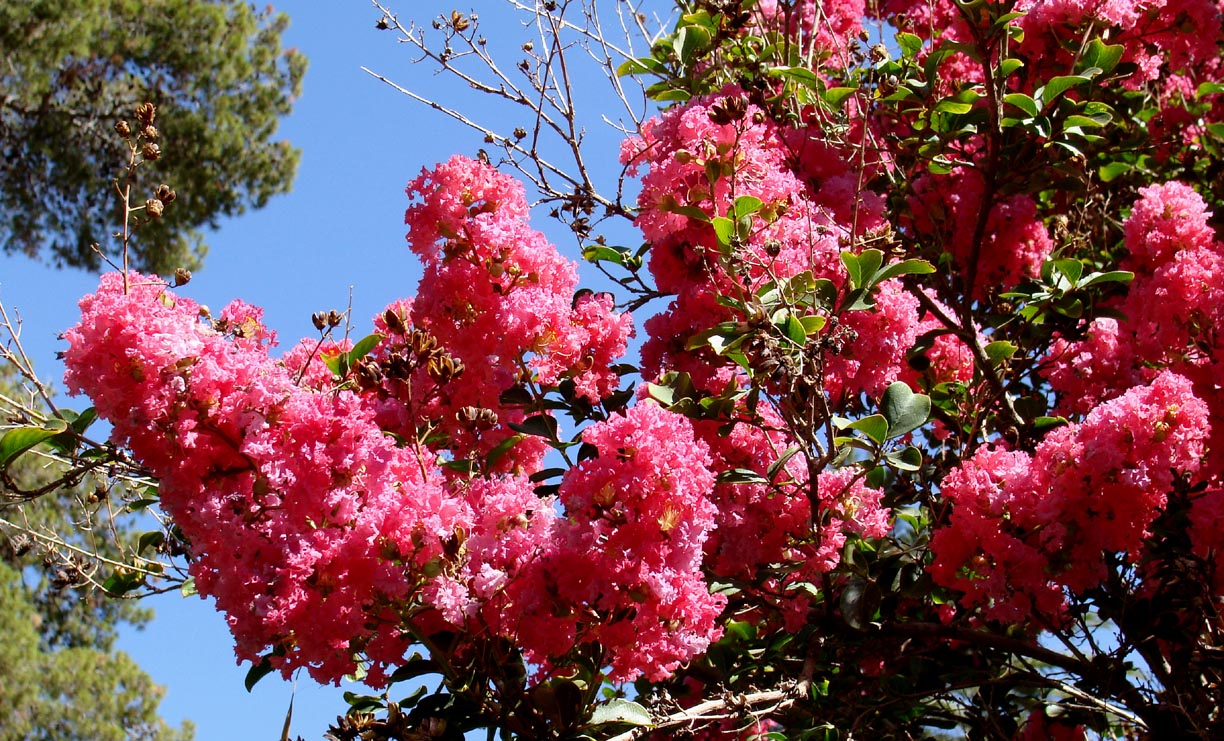
Flowers & Fruits: Multiple, terminal panicles of small flowers to 1.5-inches across, colors ranging from white to pink to red to violet; fruits in terminal clusters, green, rounded when young ripening into ugly, brown, persistent capsules.
Seasonal Color: Wonderful flower display during mid-summer and variable displays of vibrant yellow, orange, and red fall foliage color if fall and early winter weather conditions are favorable.
Temperature: Hardy, though not heat tolerant of western exposures or temperatures above 115oF. Avoid reflected light and heat. Best used in mesic surroundings with lots of landscape vegetative cover. In Phoenix, leaves are often scorched in mid-summer by the intense summer desert heat.
Light: In Phoenix, full sun in areas of good air circulation surrounded by copious vegetation (green space).
Soil: Prefers clay loam, performs poorly in sandy soil.
Watering: Regular
Pruning: Intensity and mode of pruning can vary greatly and depends on landscape use, prune in late winter.
Propagation: Mostly cutting
Disease and Pests: Aphids, scale, white flies, sooty mold, powdery mildew is especially problematic if air circulation is poor.
Additional comments: In Phoenix, crape myrtle usually suffers from heat stress during mid to late summer that manisfests as a foliar marginal browning and/or browning and premature leaf senescence. In contrast, crape myrtle does remarkedly well in the hot inland valleys of coastal and central California.
Always specify crape myrtle by cultivated variety that matches plant vigor to planting location. Some sturdier, upright and tree-like cultivars are hybrids between Lagerstroemia indica and Lagerstroemia faurei. Crape myrtle's winter deciduous habit is not preferred by many in
lower desert climate areas where 'green' is expected by 'golfing snowbirds' during outdoor winter months.
Lagerstroemia Cultivar list: Mildew resistance indicated in parentheses: (H) = high, (G) = good, (M) = moderate
|
There is also a series of cultivars in the 3 to 4 foot range known as the 'Petite' series that offer a wide variety of floral colors in a dwarf plant form of crepe myrtle, (e.g. 'Petite Plum'- deep purple). In addition, there are miniature cultivars of crepe myrtle known as the 'Dixie' series that are less than 3-feet tall. These mini-crepe myrtles tend to not be as cold hardy as those above, have a rather weeping growth habit, and do well as patio container plants for decorative display when alone or mixed with short colorful annual bedding plants, grow in partial shade, no western exposure. The 'Dixie' cultivars include 'Baton Rouge', and 'Bourbon Street' - both deep red, and 'New Orleans' - a purple flowering cultivar only 8- to 24-inches tall. The list provided above is only a small portion of the number of named cultivars of crepe Myrtle that are available.