Pronounciation: Pas-si-FLOR-a in-car-NA-ta
Hardiness zones
Sunset 5-24
USDA 6-8 (freezes to ground each year), 9 (partially deciduous), 10-11
(evergreen)
Landscape Use: Sensory gardens, edible gardens, floral accent, trellis or arbor, or wall covering. Require a sturdy support upon which to grow.
Form & Character: Spreading, vigorous, tropical, dense, aggressive, sensual, informal.
Growth Habit: Mostly evergreen, semi-woody, broadleaf perennial vine growing to 30 feet or more. Needs support to climb.
Foliage/Texture: Stems glabrous or slightly pubescent above,
striate, variable, woody, hollow, the cavity about one-half the diameter; bark very thin, greenish or purplish; wood very porous
and bordered on the inner side by a thin layer of pith; fracture of the wood
uneven, of the stem smooth, of the bark coarsely fibrous. Leaves rather thick,
glabrous or often pubescent, when entire nearly orbicular in outline, base
cordate, deeply 3 to 5 lobed, lobes are ovate, acute, finely serrate, petioles
from 0.5 to 2 inches in length with two glands near the summit. Tendrils are very
numerous and closely coiled; medium coarse texture.
Flowers & Fruits:
Flowers solitary, axillary, peduncles as long as the petioles, usually 3
bracted; calyx cup-shaped, 4 or 5 lobes; lobes are linear, imbricated,
cuspidate, corona of the fresh flowers purplish; petals 4 or 5, yellow; ovary
oblong, stalked; stamens monadelphus in a tube about the stalk of the ovary,
separated above, anthers narrow, versatile.
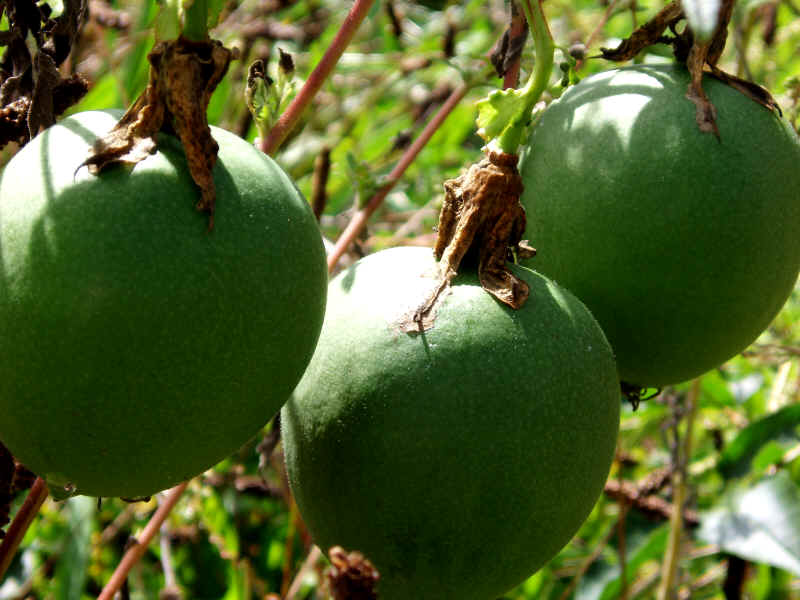
Fruit are an ovoid, many-seeded berry to 2 inches in length, externally
green or yellow, shriveled and wrinkled; seeds flat, ovate, yellowish to brown
arilled, fruit are called granadilla or water lemon.
Seasonal Color: Flowers bloom during the warm season from April to
October.
Temperature: Thrives in warm weather, frost sensitive, freezes when
temperature fall to 28oF.
Light: Partial shade to full shade. In Phoenix, passion vines grow best on an east or north exposure.
Soil: Passion vines have a high nutrient requirement requiring periodic
fertilization; use a fertilizer with a 2-1-3 ratio of N-P-K.
Watering: Requires regular irrigations in desert areas.
Pruning: Prune to control spread as needed.
Propagation: Easily roots by softwood cutting, root cuttings, stem air
layering, seed (allow unblemished fruit to ripen; clean and dry seeds
Disease and pests: Caterpillars will damage foliage.
Additional comments: In 1620, Catholic priests in Peru attached religious symbolism to this plant. The name 'passion flower' is
said to derive from a resemblance of the blue passion vine's flower to the crown of thorns placed on Christ's head. Others say that the parts of the plant
symbolize features of Crucifixion, known as The Passion of Christ. In any event, the exquisite flowers look like they are from outer space. There are dozens of passion vine cultivars producing either edible or non-edible
fruits. Passion vines attracts butterflies and have relatively weak root systems.
Leaves contain a natural sedative and have been used as a remedy for nausea and
insomnia.
The final analysis: Some people get all 'passionate' about passion vine thinking they are themselves passionate people. But alas, most are just suffering from a mild to bad case of narcissistic personality disorder.
Unblemished fruit must be significantly overripe before harvesting seed; clean
and dry seeds).