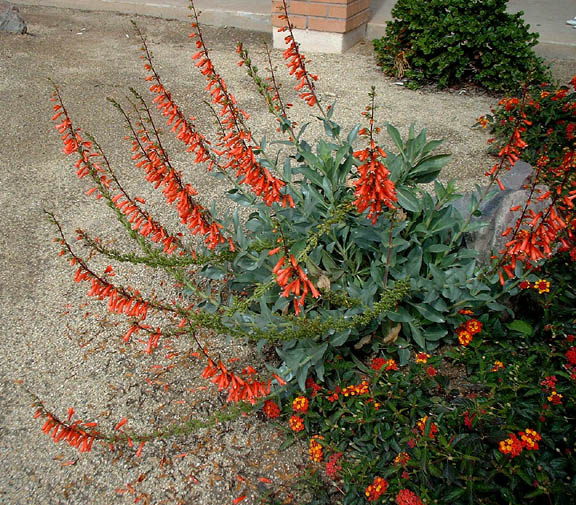
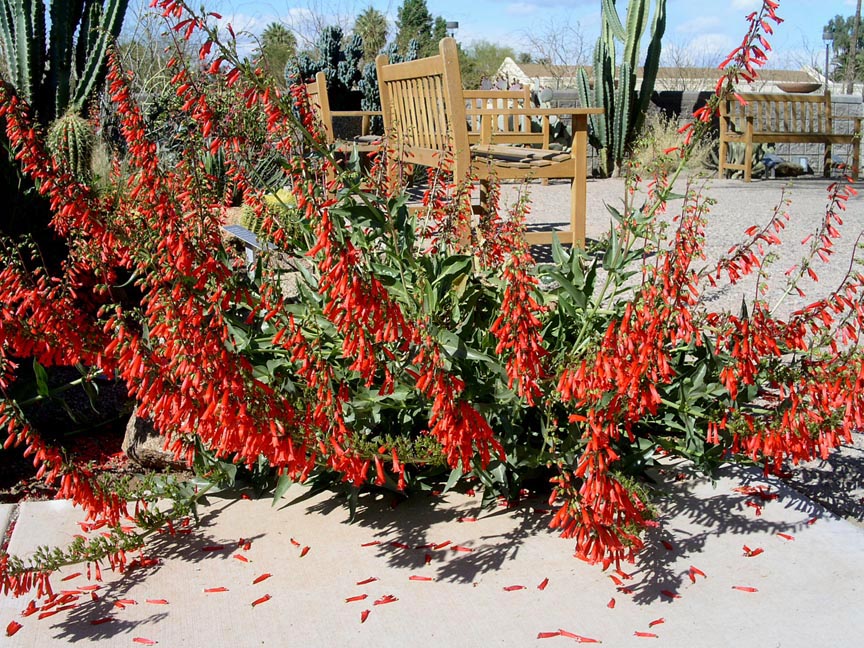
Scientific: Penstemon eatonii
Common: firecracker penstemon
Family: Scrophulariaceae
Origin: Southern California east to Arizona
Pronounciation: Pen-STE-mon e-a-TO-nee-i
Hardiness zones:
Sunset 12 and 13
USDA 9-11 (arid zones only)
Landscape Use: Winter color accent, landscape edging and border, desert flower gardens. Prefers some space around each plant for best landscape performance.
Form & Character: Forms a rosette of basal clumps that seasonally becomes upright, stiff and rigid.
Growth Habit: Herbaceous perennial, clumping with upright flower spikes to 2- to 3-feet tall with 1- to 2-feet spread. Stems are brittle and easily damaged by contact.
Foliage/Texture: Leaves are thick, glabrous, and moderate green (dull green with drought). Foliage in basal clumps during vegetative phase and along elongated stalks when the plant bolts in the winter and early spring. Basal leaves are oblanceolate with elongated petioles while stalk leaves are lanceolate to oblong to 4 inches long clasping to nearly sessile; medium texture.
Flowers & Fruits: Flowers in spikes, trumpet shaped corolla to 3/4 inch long, bright scarlet red, scarcely 2-lipped, stamens sometimes bearded. Fruit a greenish capsule.
Seasonal Color: Striking scarlet red flowers in February and March.
Temperature: Actively grows during cooler times of year staying quiescent in summer. Hardy to Phoenix winter cold, but might suffer in intense summer heat if given a full western exposure.
Light: Full sun
Soil: Must be well drained!
Watering: Infrequent summer water is required in Phoenix to maintain perennial status.
Pruning: Remove spent flower spikes after flowering in April unless harvesting seed.
Propagation: Seed
Disease and Pests: Root rot only if soil poorly drained and plants are irrigated in summer. Rarely infested with mealy bugs and aphids when plants are crowded and air circulation is poor.
Additional comments: Attracts hummingbirds!
This is a wonderfully spectacular short-lived accent perennial for mixed winter and spring desert gardens. Will reseed, though not aggressively, which is to one's advantage.
Minor factoid: There are over 250 species in this amazingly robust genus.