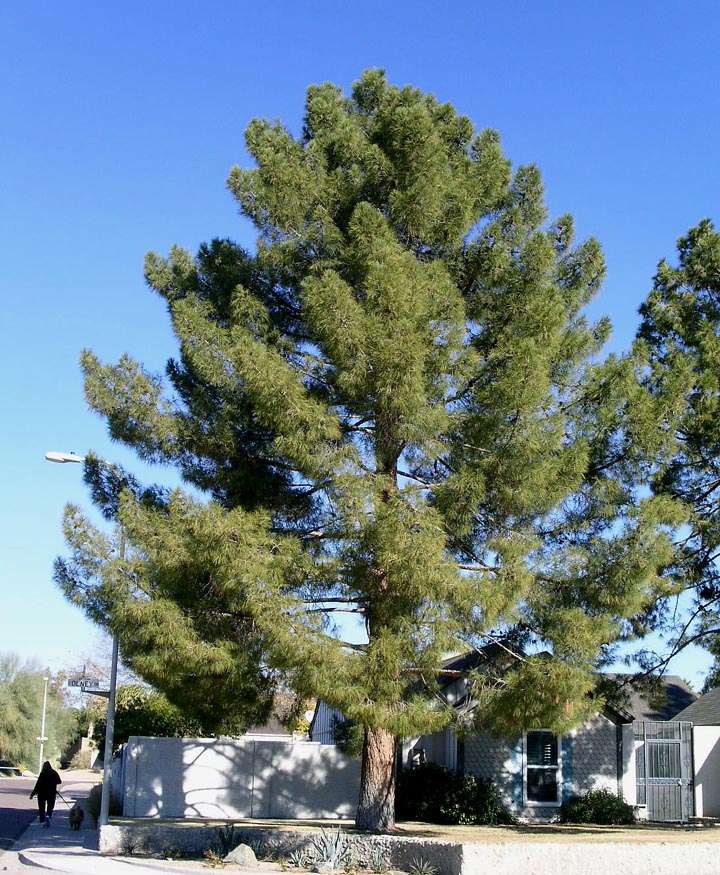
Scientific: Pinus brutia var. eldarica (Synonym: Pinus eldarica)
Common: Afghan pine
Family: Pinaceae
Origin: This near threatened taxon is endemic to Azerbaijan in southwest central Asia.
Pronounciation: PIE-nus BRU-tee-a variety el-DAR-i-ca
Hardiness zones
Sunset 5-24
USDA 6-11
Landscape Use: This is a symmetrical pine tree that casts a light to moderate shade. It's best used as a skyline accent tree or as a silhouette background tree to give strong hints of being in an urban woodland forest in the desert.
Form & Character: Upright, symmetrical, woodsy, creates the feeling of being somewhere other than the Sonoran Desert.
Growth Habit: Evergreen, woody, narrowleaf perennial tree, excurrent, slow to moderate when young to vigorous with age to 50 to rarely 80 feet, spreading with age.
Foliage/Texture: Needles two per fascicle, 5- to 6-inches long, singular (no bundle sheath) juvenile needles small blue, strongly present when young but not persistent like Pinus canariensis; medium fine texture.
Flowers & Fruits: All pines are monoecious. They technically do not flower (they are gymnosperms, not angiosperms), and reach reproductivity maturity at 7 to 10 years of age. They grow male (pollen producing) and female (cone producing) strobili on same tree during March. Female strobili develop into relatively smallish cones that ripen to full mature the following January. Seeds in cones are a single-wing achene disseminated by wind.
Seasonal Color: None
Temperature: Tolerant
Light: Full sun
Soil: Tolerant
Watering: In Phoenix, regular supplemental irrigation is definitely needed, especially during the summer months. The needle luster (length, density) and tree vigor (protection of needle canopy against sun injury to branches and trunk) are strongly stimulated with increased landscape water.
An infatic warning: In Phoenix, inadequate supplemental irrigation water given to large mature specimens can result in sudden late summer death.
Pruning: Elevate canopy base, but keeping in mind that pine stems, branches and trunks are prone to sunscald injury in Phoenix.
Propagation: Seed
Disease and Pests: Green aphids in spring. Mysterious branch and shoot dieback during late summer/fall appears related to heat stress injury in summer which might be an after-effect of inadequate amounts of supplemental irrigation.
Additional comments: This pine performs well in heat, cold, drought
and wind of the Sonoran Desert. It was once thought to be the future of "living Christmas
tree" production in the Southwest; however, the canopies of young trees were found to be too open and resistant to shearing and shaping. Afghan pines produce abundant yellow pollen during early spring and needle litter during the fall. I have observed that the single biggest problem with Afghan pines in Phoenix landscapes is tree decline and sudden dieback of larger mature trees during late summer and early fall, which is related to the failure of people to increase the volume of supplemental irrigation given to trees over time as they mature and become larger in size.
The final word: Of the several species of pine for Phoenix landscapes, Pinus brutia var. eldarica is the all-around best choice because of its excurrent habit, moderate growth rate and stately form.