Scientific: Vauquelinia californica
Common: Arizona rosewood
Family: Rosaceae
Origin: Upper Sonoran Desert scrub above 2,500 feet elevation in south Arizona and central Baja California,
often found coexisting in the Arizona uplands with with Dodonaea viscosa.
Pronounciation: Va-u-que-LEN-ee-a kal-i-FOR-ni-ka
Hardiness zones
Sunset 10-13
USDA 8-10
Landscape Use: Xeriscape, background, screen, informal hedge, highway plantings, subtle floral accent, landscape standard as a small street side tree.
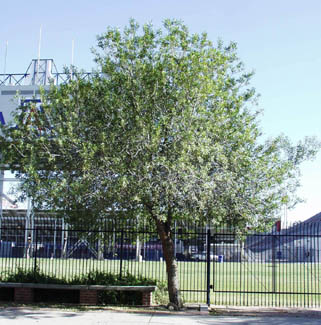
Form & Character: Upright and rounded, informally formal (confusing perhaps till you see it), slightly stiff and brittle, aridly mesic (confusing perhaps till you see it).
Growth Habit: Evergreen, woody, broadleaf perennial shrub, slow to moderate rate of growth to 10- to rarely 25-feet tall, though easily kept at 6 to 8 feet with proper water and pruning management. Some report that Arizona rosewood in Phoenix has a vigorous habit. They are mistaken, though certainly its growth rate and ultimate size is stimulated by supplemental irrigation.
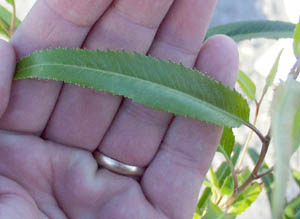
Foliage/Texture: Lanceolate and leathery, medium to dark dull green leaves with serrate margins and prominent central mid-vein, 4-inches long by 1/2-inch wide, petioles reddish, stems gray; medium texture.
Flowers & Fruits: Small, white flowers in umbels followed by ugly brown small brown fruit, persistent.
Seasonal Color: White flowers over a relatively short period of time, late April to May.
Temperature: Tolerant of all but the very hottest Phoenix weather, foliage begins to yellow. Phoenicians know well these hottest days of summer when the thermometer soars above 110oF.
Light: Partial to full sun, only moderately tolerates reflective heat and western exposures in low desert.
Soil: Well-drained soil is best.
Watering: Infrequent deep supplement irrigations during summer are needed.
Pruning: Prune lightly only to shape, do not shear.
Propagation: Seed, sometimes cutting.
Disease and Pests: Texas root rot
Additional comments: Arizona rosewood is valued as a nonpoisonous substitute for
oleander, although its early summer flowering is not nearly as spectacular and occurs over
only a couple of weeks. In Phoenix, young Arizona rosewood plants are relatively slow to establish in landscapes and are prone to some summer heat stress.
In general, Arizona rosewood performs better in Tucson than Phoenix because the former
is at higher elevation and is slightly cooler overall. Arizona rosewood is also highly sensitive (severe foliar chlorosis) to ground applied pre-emergent herbicides such as PrincepTM.
Taxonomic notes: The genus Vaquelinia was named after Louis Nicolas Vauquelin (1765-1827), French chemist and botanist. Although the plant is found in isolated pockets in Baja California, the species name, californica, "from California", is misleading to some since this plant does not naturally occur in the state of California. However, botanists for the last 150 years have typically treated Alta California (the state of California) and Baja California as one geographical unit. Other native Vauquelinia species include Vauquelinia angustifolia and Vauquelinia corymbosa ssp. angustifolia.