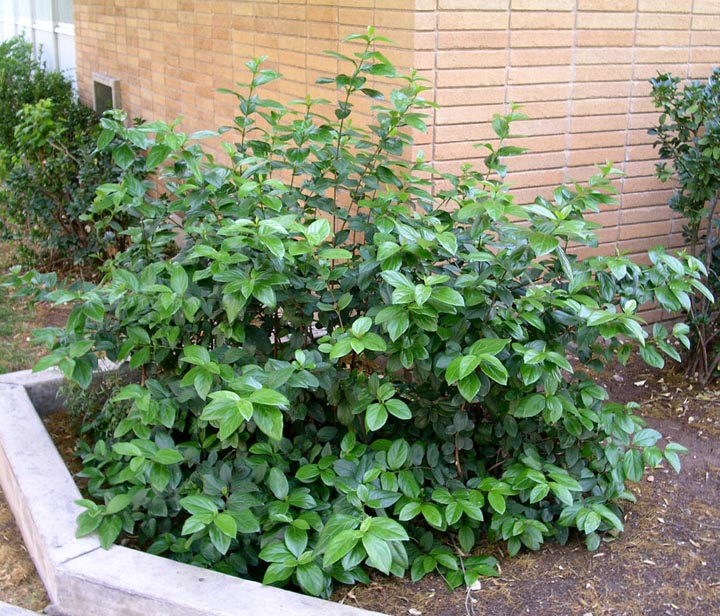
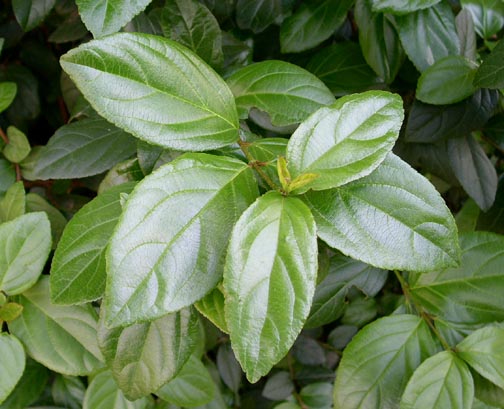
Scientific: Viburnum suspensum
Common: sandanqua viburnum, sandankwa viburnum
Family: Caprifoliaceae
Origin: Okinawa and the Ryukyu Islands, which are a chain of Japanese islands northeast of Taiwan.
Pronounciation: Vi-BUR-num sus-PEN-sum
Hardiness zones
Sunset 8-10 (some cold damage can be expected), 12-24
USDA 8-11
Landscape Use: Informal hedge, background, screen, foundation, filler, historical plantings in and around old-style landscape gardens, Victorian architecture, mesic design themes.
Form & Character: This is a sturdy, large, formal, shrub with a formal, rounded and dense appearance, historical, antebellum.
Growth Habit: Evergreen, woody, broadleaf perennial shrub, moderate growth rate and can be maintained at heights of 5 to 12 feet with an equal spread.
Foliage/Texture: Leaves have an opposite orientation (2 leaves per node), oval, bluntly dentate leaf margins, prominent foliar venation patterns; medium coarse texture.
Flowers & Fruits: Clustered, flower buds pinkish red, flowers small, white, somewhat tubular, musty fragrance like that of a 'granola girl hippy'; fruits are a small round dark reddish blue drupe.
Seasonal Color: Dense clusters of white flowers in late winter/early spring are marginally ornate.
Temperature: Tolerant of Phoenix summer heat if not exposed to western sun.
Light: Partial sun with complete avoidance of reflected south and open west exposures.
Soil: Tolerant, but well drained.
Watering: In Phoenix, applications throughout the year of supplemental water is a requirement.
Pruning: Use heading cuts to prune to shape, best done after flowering in spring. Can be severely pruned to near ground level to rejuvenate, but never shear because of its larger leaves.
Propagation: Seed, but more commonly propagated asexually using semi-hardwood cuttings.
Disease and Pests: Spider mites, thrips and aphids.
Additional comments: In the Phoenix area, sandankwa viburnum is an old-fashioned, serviceable landscape shrub for historic, mesic landscape design motifs. It is quite rare to find today in the local nursery trade and was used in Phoenix landscaping more during the early to mid 20th century when flood irrigation was the most common way to irrigate landscape gardens.
A broader perspective: Viburnum is a very diverse genus containing a number of popular landscape plants grown in landscapes gardens across the United States in regions with a more temperate and humid climate (kinda like everywhere in the United States except the American desert southwest).