Scientific: Viguiera deltoidea
Common: golden eye
Family: Asteraceae
Origin: Sonoran Desert at elevations between 1,000 and 3,500 feet, mostly
on disturbed sites.
Pronounciation: Vi-gu-I-er-a del-TOY-Dee-a
Hardiness zones
Sunset 11-13
USDA 9 (arid zones only)
Landscape Use: Small sub-shrub best used as an accent or filler plant in desert and rock gardens, desert restoration, native plantings or xeric landscape design motifs, as a foundation or filler plant. Sometimes landscape architects will try to "go native" and spec this plant as an hedge in a sidewalk planter....this is horticulturally weird, especially when the 'Horticultural clods of Phoenix' (aka'Hort clods') are charged with 'taking care of it'.
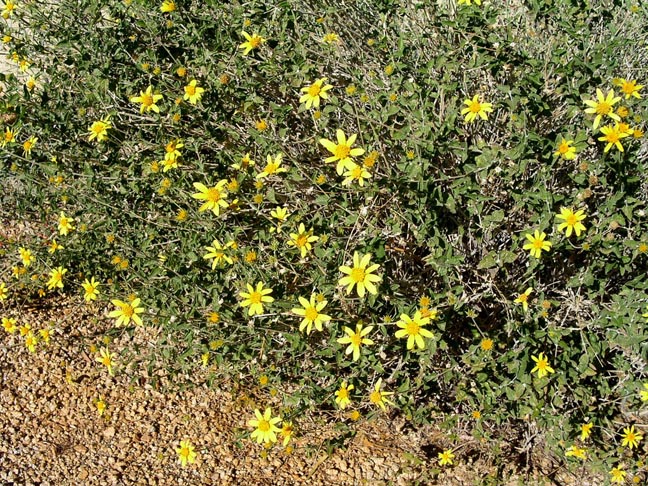
Form & Character: Open, rounded to irregular, and sparse without irrigation, brittle, stiff, cheerful in flower, otherwise bland to boring.
Growth Habit: Evergreen, herbaceous to semi-woody, broadleaf perennial shrub, moderately slow grower that branches mostly from its base at ground level. Eventual maximum height is 3 feet with an equal spread, somewhat larger if heavily irrigated.
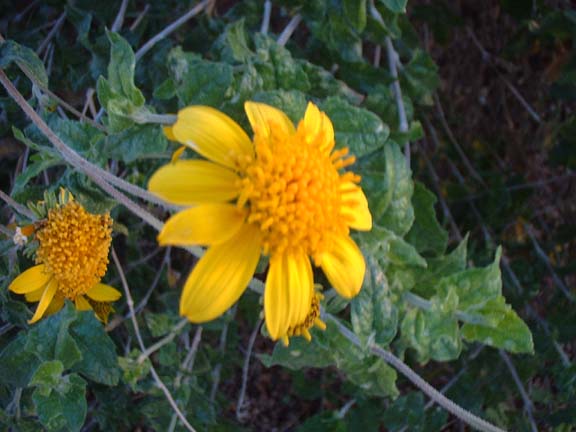
Foliage/Texture: Deltoid-shaped foliage, broadest at the base and narrow at the apex, roughly pubescent, medium green,; young stems are greenish gray and pubescent, older stems stems are gray, stiff, and brittle; medium fine texture.
Flowers & Fruits: Flowers bright yellow, daisy like, medium small, 1- to 2-inches across, peduncles are long and pubescent, fruit inconspicuous.
Seasonal Color: Yellow flowers sporadically during the warm season.
Temperature: The shoots of this plant will suffer freeze injury at winter temperatures below 25oF, quick to recover. Highly tolerant of summer heat.
Light: Full sun, avoid shaded locations.
Soil: Very tolerant of even caliche soils.
Watering: Highly drought tolerant once established. Supplemental irrigation produces more vigorous and succulent to rank growth that is less tolerant of the desert extremes in temperature and moisture.
Pruning: Lightly shear this plant once a year during late spring.
Propagation: Seed
Disease and Pests: Relatively pest free.
Additional comments: As the popularity of native plants in Phoenix urban landscapes grows, plants such as golden eye will become more commonly used and available in nurseries. Golden eye is an excellent herbaceous perennial for Sonoran Desert restoration projects.