ART EDUCATION IN CULTURAL CONTEXTS

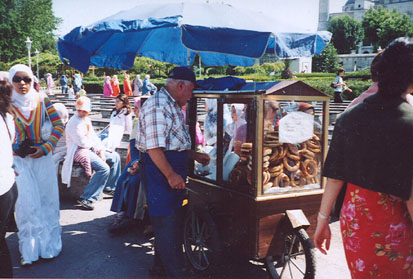
The 2004 International Society for Education through Art Conference in Istanbul and Cappadocia Turkey
Dr. Mary Stokrocki,
Professor of Art Education Office:
Art Building 252 Time: Thursdays, 4:30-7:30
QUALITATIVE INTERVIEWING [Outside link]
QUALITATIVE FORMS OF ART EDUCATION RESEARCH [Outside link]
EXAMPLE STUDIES BELOW:
Art Criticism in Turkey:
Prospects and Problems of Exploring a Tapestry
Relationship of multicultural perspectives to teaching and learning art criticism, aesthetics, studio art, and art history; in the local and global contexts.
Global education should not be viewed as a discipline with particular content or subject matter, rather it should be seen as an approach to the study of culture that can focus on international concerns or those related to study of studentsÕ own local communities (Zimmerman, 1990).
The goal of experiential education is an increase of understanding (Deborah Smith-Shank). Sometimes misunderstandings are unfortunate, but as Lotman (2000) explains, not only understanding but also misunderstanding is a necessary and useful condition in communication. A text that is absolutely comprehensible is at the same time a text that is absolutely useless. An absolutely understandable and understanding partner would be convenient but unnecessary, since he or she would be a mechanical copy of my and our converse would provide us with no increase in information: just as there is not increase in money if one passes a purse from one pocket to another. A dialogue situation does not blur the distinctions between the partners, but intensifies them and makes them more significant (Lotman, 2000, p. 80).
Course Book from Alphagraphics. See Student Model Final Project: ÒQualitative Interviews of three Korean American Students: Gaining Cultural Knowledge by Karla Primosch
Irwin, R. & Kindler, A. (eds.). (1999). Beyond the school: Community and institutional partnerships in art education. Reston, VA; NAEA. ISBN#: 1-890160-09-1
SEE THE ARIAD RESEARCH DATA BASE: http://www.ariad.co.UK [UNITED KINGDOM ] Also see AustraliaÕs (au) version at bottom of page.
Stokrocki, M. (2004) Contexts for Teaching Art. In E.. Eisner & M. Day (Eds.).Teaching and Teacher Education Handbook on Research and Policy in Art Education (pp. 439-466). Mahwah, NJ: Lawrence Erlbaum.
The course will introduce students to the international realm of art education and local subcultures. By studying an unfamiliar culture, students learn a great deal about our own biases and related issues in the field.
COURSE EXPECTATIONS ATTENDANCE POLICY:
FOR EVERY THREE ABSENCES, GRADE IS DROPPED one letter grade; Three lates = one absence; Students are responsible for notifying the instructor in advance before the end of the first week of classes if absences during that period cannot be avoided. Reasons for absences must be in writing (with a doctor's reason). Have a stamped date on it from the office. Late work: For everyday a project is late, including weekends and holidays, one-third of grade is dropped.
PARTICIPATION POLICY: Attendance and Participation counts heavily. You can redo a project once within a week, except the FINAL. You are expected to arrive to class on time. Participation in aesthetic dialogue also demands reasoned responses and questions, not just your own opinion. Submit the original with the redone work and have the office stamp the date. Students who are absent must complete the handouts on the class readings or grade with be dropped accordingly.
PROFESSIONAL QUALITY: All projects must be typed and proofread. Keep copies of your projects in case they get lost. If you want an "A" grade, you must be prepared to work for it. You must give me a copy of your final paper.
ART IN CULTURAL CONTEXTS FINAL PROJECT -- QUALITATIVE INTERVIEWS
Name _______________________ Culture ________________________ Site_____________________________ Contact Person __________________________, e-mail#
DUE DATE: POINTS: ASSIGNMENT
Feb. 12; __10pts. THEORETICAL FRAMEWORK AND METHODS: Qualitative Interview or Oral History Research Questions. IN AN ESSAY FORMAT. [PARAPHRASE]
FEB 26 __/10pts. INTRODUCTION, CONTEXT, PARTICIPANTS , FIRST IMPRESSIONS. Why I am interested in these participants and why I chose these three particular people, and How and where you interviewed them.
APRIL 1; __20pts. FIRST INTERVIEWS and MARGINAL & COLOR CODING, TABLE: ANALYSIS OF FIRST INTERVIEWS. ANSER THE FIRST SET OF FINAL SUMMARY QUESTIONS
APRIL 29
FINAL PRESENTATIONS AND REMAINING SECTIONS DUE Poster Session or Final Presentation. See requirements below.
/10pts. SECOND INTERVIEWS: Art Criticism of Work (3 people--one artwork each). Artwork needs to be a similar type. Compare results.
/10 ART ORIENTATIONS
/10pts. COMPARATIVE ANALYSIS with Related Article, Internet Sites, or Exper
/10pts. CONCLUSIONS: Summarize your Findings by Comparing These Cases and Answer your Research Questions. Conclusions are more [human] naturalistic generalizationsÑyou are generating insights not predictions. Remove yourself and students names. For example, report: art orientations seemed diverse or Two out of three students may agree. Families probably affect students ___. Use these supposition verbs to interpret results. You can include quotes from other research here as well to support your claims.
/10pts. SUMARY of ARTICLES, Update with Internet Site.
/10pts. PARTICIPATION and ATTENDANCE
/100pts. TOTAL
SCHEDULE: ART IN CULTURAL CONTEXTS
[Tentative Schedule:I reserve the right to change dates due to speakersÕ changing situations.]
INTRODUCTION TO QUALITATIVE INTERVIEWING AND ORAL HISTORY Stokrocki, M. " Oral History: Recording teacher folklore & folkways." Due: Feb. 12 Theoretical Framework on Qualitative Interview Concepts and Procedure (10 points).
READ AND DISCUSS: BEYOND THE SCHOOL: COMMUNITY AND INSTITUTIONAL PARTNERSHIPS IN ART [Doctoral Students]
GUEST SPEAKER: JAPANESE INTERNMENT CAMPS-MASUMI HAYASH
CULTURAL APPROPRIATIONS & PEDAGOGY OF THE OPPRESSED & CULTURAL CANNIBALISM IN BRAZIL ISSUES: What is American Art? What is Beauty? How are images appropriated? How are we oppressed? Discuss male-dominated arts and issues (advanced white male syndrome) and female-dominated arts and issues (art of housewives). Discuss the influence of commercial world on fashions. See video on Holy Week in Ouro Preto and Colombian Artist Botero.
ART ORIENTATIONS (John Michael) Discuss how to do comparative analysis charts.
DUE TODAY: THEORETICAL FRAMEWORK: ANSWER QUESTIONS ON QUALITATIVE INTERVIEWS AND ORAL HISTORY IN AN ESSAY FORMAT. [PARAPHRASE]
Read: ÒRitual and Aesthetic Education: The Sweat Lodge ExperienceÓ in Boughton & Mason (1999).
THROUGH NAVAJO STUDENTSÕ EYES &PHENOMENOLOGY OF THE SWEAT LODGE TEACHING EXPERIENCE with GUEST SPEAKER ALAN JIM, NAVAJO LEADER & SUNDANCER. Bicultural Education of Native People. COMMUNITY Kathy David Reflections on Yavapi Read: Mason, R. (1994). Artistic achievement in Japanese junior high schools. Art Education, 47(1), 8-19.
JAPANESE ART EDUCATION MONOCULTURALISM AND THE MANGA:An exchange of artworks. Guest Joani Share. [See Matsuri Festival in Phoenix: Feb. 23-24, 2002ÑKimona Fashion Show, Tea Ceremony, Art of archery] Create paper crane sculpture.
DUE TODAY INTRODUCTION, CONTEXT, PARTICIPANTS, FIRST IMPRESSIONS.
ECOLOGICAL AESTHETIC EDUCATION: THE POLISH MODEL SOCIAL RECONSTRUCTION, PEACE EDUCATION & POLISH GREEN--ECO SCHOOL
DUE: INTRODUCTION, PARTICIPANTS, FIRST IMPRESSIONS, CONTEXT.
Read: Ballengee-Morris, C., & Stuhr, P. (2001). Multicultural art and visual cultural education in a changing world. Art Education, 54(4), 6-13.
Anderson, T. (2002). Mandala constructing peace through art. Art Education, 55(3), 33-39.
TOWARD A CULTURALLY-BASED PEDAGOGY: Discussion of the technology and meaning of Eskimo aesthetics: the importance of touch, storytelling, and the spiritual and practical arts. RITA IRWIN & MULTICULTURAL CREATIVITIY (Blindfold for focus perception).
Read: Swinton, G. (1978). Touch and the realÓ Contemporary Inuit aesthetics Ð theory, usage and relevance. In Greenhalgh, Michael & Megaw, Vincent (Eds.). Art in Society: Studies in style, culture and aesthetics (p. 71-88). New York: St. MartinÕs Press.
Read: Lipka, J. (1991). Toward a Culturally based pedagogy: A Case study of one Yup'ik Eskimo Teacher" Discourse Pattern, Student Responses, Cultural Values, Social Relations (Storytelling and making a beaver blanket).
Read: Nelson, P., & Baker, J. (1992, June). "Meaning in Mud: Yup'ik Eskimo Girls at Play." Anthropology & Education Quarterly, 23 (2), 120-144. TREAT IN MUD
COMPARE YOUR RESEARCH TO THE RELATED STUDIES IN THIS ARTICLE--CONTEXTS FOR TEACHING (pp. 439-466). WRITE A PARAGRAPH.
COMMUNITY BASED-LIFELONG LEARNING, NAEA --ART OF HOMELESS & HOUSEWIVES, Sandy Andrews & Muriel Magenta Guest Speakers
Read these articles & Find related websites:
Mullen, C. (1989). The Artistic Worlds of Seven Housewives. Journal of Cross-cultural and Multicultural Research in Art Education, 7, (1), 56-68.
Read: Mason, R. (1999, Sept, 20-26). Celebrating artful experience in the Home. Paper prepared for InSEA 30th World Conference, Brisbane, AU.
Read: Blaikie, F. (1984, May). Getting by in township schools in South Africa. Art Education. 34-38.
Read: Blandy, D. "Community-Based Lifelong Learning in Art for Adults with Mental Retardation: A Rationale, Conceptual Foundation, and Supportive Environments. Studies in Art Education, 34 (3), 167-175.
Read: Pfeuffer Guay, D. (1993). Normalization in art with extra challenged students: A problem solving framework. Art Education, 58-63.
GLOBAL & INTERCULTURAL EDUCATION IN HOLLAND: HOW TO WRITE CONCLUSIIONS AND GIVE EXAMPLES
Conclusions are more [human] naturalistic generalizationsÑyou are generating insights not predictions. Remove yourself and students names. For example, report: art orientations seemed diverse or Two out of three students may agree. Families probably affect students ___. Use these supposition verbs to interpret results.
Read:
Zimmerman, E. 1990). Teaching art from a global perspective. ERIC ART.
Stokrocki (1989). Teaching Art to Multicultural Students in Rotterdam: The Art Teacher as Intercultural Educator. Journal of Multicultural and Cross-cultural Research in Art Education 7 (1), 82-97.
Slide Presentation and Discussion: Anthropological Study of Two Communities' Competition and Cooperation over a Flower Parade: "Art for Two Days" by Johann Ligvoet (The Netherlands)
DUE: FIRST INTERVIEWS AND CODING & INTERNAL COMPARATIVE ANALYSIS CHART
LATINO COMMUNITY OUTREACH & BEAD MUSEUM: Guest Speaker JUDY BUTZINE from the Bead Museum. In Class--Make prayer arrows.
Divide articles to read:
Lackey, Louana, "Learning to be a Potter in Acatlan" " (Family training and ceramics class). In Art in small-scale societies, 170-178.
"The Kites of Santiago Sacatepequez" (Male-dominated). In R. Anderson's, Art in small-scale societies. [Construct kites out of tissue paper & decorate them to attract a mate]. Due to disastrous earthquake in 1976, the kite festival is no longer in existence.
Stokrocki, M. "Guerrero family art traditions." In K., Congdon, D. Blandy, & P. Bolin (Eds.). Histories of community-based art education (pp 42-53). Reston, VA: NAEA.
Keys K. & Ballengee Morria, C. ( 2001). Car art & cruise in: A tour through community culture.
ART EDUCATION IN FUNDAMENTALIST CULTURES: Art Education in TURKEY & Figural Exceptions to Fundamentalist Islamist Taboo (Karagoz Puppets)
Read: Stinespring, J. (1990). Fundamentalist religion and art teaching: Responding to a changing world. Art Education, 43(3), 50-52.
ÒPeace Education through art: Nordic Paradise and Study of Conflict and Harmony" (Heta Kauppinen.).
See INSEA/UNESCO Website
Special In-Class Project: Create a Peace Mandala out of natural flowers (pollen) for peace. Mandalas are temporary works, composed of sad, grain, pollen, flower dust, and other natural materials and are accompanied by chanting, prayers, and blessingsÓ (p.34). Similar to a Navajo "Sing," they heal by balancing the world.
FINAL POSTER or FINAL PRESENTATIONS
I wrote out my observations in the form of a diary, flowing the model profile (Folsom, 1976). I transcribed them into the computer. I began to analyze this data with borrowed concepts--art orientations from Michael (1970). As time progressed, I began to notice other emerging concepts or repetitive patterns in three cases. I started color coding them in the margins of my transcripts. I developed a color code key and defined the concepts. Then I reorganized my diary notes to be consistent with each case.
Later, I wrote each case individually and developed a comparison chart
Note: Concepts are abstract ideas; some are simple like the idea of redness and others are more complicated such as subtle cultural hatred. Some are scientifically known; some are popular; others exist as folk metaphors; some are hidden (tacit knowing).
Example Chart of Emerging & Borrowed Concepts of Three Junior H
| Chris | Matt | Tommy | |
| Appearance | proper | jock | hiphop |
| Behavior | shy | very social | antisocial |
| Favorite Artist | Van Gogh | ||
| Art influences | older sister | coach | art teacher |
| Art Orientation | intellectual | primitive | intuitive with some intellectual |
| Project 1: Animal Drawing | detailed | stereotyped | expressive-wild |
| Last Project: 3D Animal Mask | owl small rigid helmut | lion with mane with nose in the round | dog, less detail unfinished more expression |
Example Chart the Results of Content Analyses of Three Gentlemen's Cases:
| Mr. L | Mr. T | Mr. S | |
| Disability | |||
| Art Media Preferences | |||
| Attitude towards art | |||
| Response to Cassatt's work | |||
| Art Orientation | Mechanical | Schematic | |
| Color Wheel Results | |||
| Still Life Result |
(See Figure 1A&1B) (See Figure 2A &2B) (See Figure 3A & 3B)
From Folsom, S. (1976). The art educator in the preadolescent world: A phenomenological descriptive study of teacher and children. (Doctoral dissertation. Penn State University, 1976). DAI 37 (11A), p. 6903. (Microfilm No. 77-09765]
POSSIBLE LOCAL SITES for FINAL PROJECT
NATIVE AMERICAN SITES: CIBECUE APACHE, WHITE RIVER APACE; YAVAPI TRIBAL SCHOOL , DESERT EAGLE SECONDARY SCHOOL (MARICOPA/PIMA), YAQUI COMMUNITY SCHOOL
SUDANESE IMMIGRANTS
LOCAL COMMUNITY CENTERS: ARIZONA
MUSEUM FOR YOUTH (MESA)
COWBOY ARTISTS;
FAMILY ART MUSEUM [PHOENIX]
CULTURE SCHOOLS ON SATURDAY: CHINESE, POLISH SUBCULTURES:
ART CARS, BIKER CULTURE, Tattooing & Makeup Artists SKATE BOARD CULTURE ART FOR PHYSICALLY-CHALLENGED Ð
SHEMER CENTER (CAMBLEBACK): ART & PHYSICALY HANDICAPPED
RELEASE THE FEAR: ROBERT MILEY (602) 258-6107 (conflict resolution and healing power of education through art).
ART WITH THE ELDERLY: Quilt groups at Friendship Village-Mesa
HISPANIC COMMUNITY SITES: MERCADO MUSEUM AND UNIVERSITY PARTNERSHIPS
ART IN PRISONS
JAPANESE MATZURI FESTIVAL: Tea Ceremony & Pottery, Calligraphy
SCHOOL FOR HOMELESS: Thomas Pappas School in Tempe & Phoenix;
VICTIMS OF DOMESTIC VIOLENCE;
FREE ARTS OF ARIZONA