 Suggested Horns, Mouthpieces, and
Mutes Suggested Horns, Mouthpieces, and
Mutes
My favorites within in the price range of
students and amateurs
John Ericson
The plain fact is that there are things that a change of horn
and mouthpiece will instantly impact for the better.
A Better Horn?
Every horn
player is (or at least should be) interested in finding better equipment. But
what equipment is better? Any answer to this question is colored because every
horn teacher is biased by both their individual sense of "what works" both professionally for
them right now and for their current students. Plus, their playing is probably somewhat hardwired around a type or style of horn or mouthpiece.
As a
teacher I am very comfortable teaching students who have different tonal ideals
and would not insist that a student use any particular brand or model of horn; I
just want to feel that it is, in fact, a good instrument, no matter what their
tonal ideal is.
Good and bad horns can be made from
brass or nickel silver, can be large or small bore, etc.
Different types of horns will be preferred in different places
and it is to your advantage to aspire to fit into the musical situation that you
have the closest affinity for. While there has been a strong trend
toward Geyer style horns in recent years, I still would
suggest if at all possible speaking to several horn players and teachers in your area. What you want to obtain is a horn that is of the quality
level that a professional would consider playing it, and you
also want a horn that should retain some resale value in your area.
Beginner Horns
For a very young beginner I would
absolutely consider the use of a single B-flat horn rather than the
traditional single F horn, the B-flat horn fingerings being the same as
those used on the B-flat side of a double horn (reading the music in F!). More on this topic may be found here. Another alternate to consider is the 3/4 size double horn, which I describe here.
A bigger issue is that while we have some
of the best horns ever made on the market now, we also have some of the
worst horns ever made ... be very wary of the very cheap horn! There are
reasons why they are so cheap!
Intermediate to More Advanced Horns
As to a more professional level of horn, one way I often answer the question of what horn
do I recommend is this--if
I had to buy a new double horn right now, what would I purchase? I am not really sure, honestly, but the reason why is good--there really are quite a few good custom double horns out there on the market.
When you get over into the price range of professional quality instruments (roughly over $7,000) I have tried a lot of instruments I have liked. For most players the choice ends up being some combination of what horns they have heard good things about and what horns they can actually get their hands on to try.
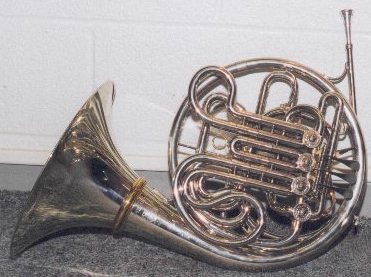
I made my first two solo CDs on the big Paxman 25A
at the top of this page. The 25A is a larger bore horn generally similar to a big Kruspe type horn but
with some of the responsiveness I associate with a Geyer style horn. It was purchased because it was a quality horn available at a time when I needed to replace my (very tired) old 8D.
I used that horn for years but, keeping
my eyes open and seeing the trends, I became interested
in owning something a bit smaller with a more focused sound--a custom Geyer type horn (see this article for more on the topic of Kruspe or Geyer). I
actually won my job in Nashville playing a Yamaha 667 (a Geyer style horn), but during my time there switched
back to a pre-letter Conn 8D (Kruspe style), a horn I had played as an advanced student, with a Lawson flare (and several different upgrade leadpipes) to better match the (then) mostly Lawson section of the Nashville Symphony
(now all playing Geyer style horns...).
Which brings me to today. While I
use both types regulary, my main horn as of now is a Patterson
Geyer model R horn. It practically plays itself!
 But
let's say you don't have $10,000+ laying around to buy a high end custom
horn. I
have had two very specific, less expensive suggestions for students and for amateurs looking for
new horns.They are the But
let's say you don't have $10,000+ laying around to buy a high end custom
horn. I
have had two very specific, less expensive suggestions for students and for amateurs looking for
new horns.They are the
- Hoyer 6800 series
- Yamaha 671
The Hoyer 6800 series horn is a
larger bell ("Kruspe") horn in nickel silver or brass (my students seem to mostly
purchase the nickel silver version) and the Yamaha 671 is a smaller bell ("Geyer") brass horn
(in 2016 it replaced a similar model, the YHR 667).
What I like about these specific models is even as built they are both capable of producing a good "professional" sound and can both be upgraded
if desired.
But there are other valid options and the market
(especially at a professional level) has really
moved away from nickel silver horns. To be a bit more specific, I have
also seen students of mine purchase Pope-Balu (Briz) and Finke horns at close to
the price range of the Hoyer and Yamaha horns just mentioned, and then when you go a bit higher, there are so many
good
options.
All of the suggestions above are very much aimed at our performing market in the United States. If you are overseas you will need to consider carefully what horn models are popular where you are and adjust your setup accordingly. Above all you want to fit in with your local performing situation if you aspire to work professionally, no matter where you are.
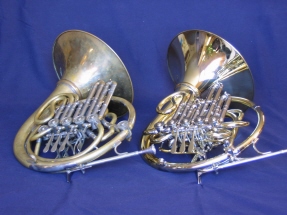 I also regularly play on several other horns including a triple horn and a descant. These horns both definately have a place for the professional or aspiring professional hornist, especially a high horn player who is established in a job, and frankly most of them on the market today are very nice horns. A triple or descant is not typically owned by students, however, as they are not as suited to general playing by the average hornist as would be a standard double horn. I also regularly play on several other horns including a triple horn and a descant. These horns both definately have a place for the professional or aspiring professional hornist, especially a high horn player who is established in a job, and frankly most of them on the market today are very nice horns. A triple or descant is not typically owned by students, however, as they are not as suited to general playing by the average hornist as would be a standard double horn.
The Mouthpiece
On mouthpieces,
I would first suggest in general that hornists don't use the mouthpiece that
"came with the horn." For two reasons. First, a change of mouthpiece can make an incredible
difference. Second, modern horn mouthpiece designs made on a CNC lathe
are much better overall than cheaper mouthpieces made in the standard
manner.
Horn beginner mouthpieces are not nearly
as standardized as what you see in other brass instruments, there is no
horn equivilent of the "7C" that is so standard as a beginner trumpet
mouthpiece. For the beginner I have most recently been suggesting the
Yamaha 30C4. It is a small and very easy to play mouthpiece and Yamaha
has good quality control. The Schilke 30 is also a good choice for the
same reasons. Please avoid use of a very generic mouthpiece -- get a good one, it
is worth every penny.
Also, this may sound severe, but if you are
a serious player using a mouthpiece of the types common in the previous
century, it is time to change. It is past time! This is a golden age
today, with some of the best horn mouthpieces ever produced available. The
old lines, there were quality control problems for sure, and in the big
picture some of the old standards that are still
in use are in fact poor choices.
This past couple years my students and I have made much use
of Houser mouthpieces and also the
Houghton line of mouthpieces, made for them by Houser. The
whole line is good, but if I had to pick just one model to recommend to the world,
it would be the
- Houser San Francisco cup
14-0-2 (which I understand to be the most popular of their models)
Worth mentioning as well, some players should consider using a wider than standard inner diameter mouthpiece.
Houser has a variety of size options available in their line of rims. A larger inner diameter can really open things up for some players; the old standard mouthpieces popular
35 years ago (for example Giardinelli) are really more intended for people with fairly thin lips.
So what do I
play? I have changed a lot of
times but as of this update (7/2020) I use a stainless Houghton
H-4 with a H-3 rim on the Patterson. But I have other horns I
use and I've been rotating horns with COVID practice. On the other
horns, I use versions of the San Francisco cup. On the Paxman 25AND I
use the brass 16-0-2, on the Alexander single Bb I use the brass 14-E-2,
on the Paxman 85 triple I use a stainless 14-0-2, and on the school 8D
at my office I like the brass 14-0-3. If you don't have at least 5
mouthpieces in your collection, you need more, and all of these listed
are nice models to consider.
Braces are a special problem. For a student with braces
you might try to locate this vintage mouthpiece:
This model has an unusually wide,
reverse peak rim design which spreads the pressure well. I found this
mouthpiece to be useful during a period when I had a lip injury, and
some teachers also find this mouthpiece useful in working on
embouchure changes. Unfortunately, this mouthpiece has been out of
production for many years but Osmun (and probably others) can supply you with a copy
of the rim to fit a screw rim cup. The extra comfort is worth the expense
to explore as an option compared
to other options with braces. I discuss the topic of Neill Sanders mouthpieces further in this article.
Finally, do be sure that any mouthpiece you use is properly sized
for your horn leadpipe inlet. There is a distance that a mouthpiece should fit
into the receiver; if it goes in too little or too far things will not work as
well as they should, but fit correctly everything comes into focus.
The reason I emphasize this point is
that some European horns (in particualr Alexander and Schmid) really need a mouthpiece with a larger, European shank to play at their best.
Several makers offer European shank versions of their mouthpieces for this very reason.
Always start with a standard shank, but if your mouthpiece visually goes
in further than on most horns you would be wise to obtain a mouthpiece with a
larger shank and give it a try.
It could be just the thing you need to bring a horn into focus, or it could make things really stiff -- which would indicate that you
maybe don't need the larger shank. Houser mouthpieces have a very clear
system in relation to shank fit which is a wonderful thing to have. In short:
How to Try a Horn or Mouthpiece, in Brief
The main thing I would note is you can tell a lot very quickly by focusing on two specific types of passages in your initial testing.
- Lyric, soft passages, preferably ones with slurs some of which are over harmonics and others of which have valve changes
(focus on the connections between the notes) and
- Louder, articulated passages that go from the lower range (around written middle C) up into the upper range.
Feel how the notes speak and have others listen to give you feedback. Try to get in a good hall if possible, or at least the best room you can, and try things back to back. You can tell quite a bit with recording yourself, but feedback from a fine horn player will help even more, they will hear the differences. Also, you will be able to tell
pretty quickly which option is the easier to play on option, and usually that option will in fact be the best option. Finally, if
a horn has no high Bb, walk away! See this article in Horn Matters for more information on trying a horn.
 And
then we have Mutes And
then we have Mutes
There are a lot of mutes on the market, each with a unique
shade of tonal color and slightly different playing qualities. If you can, try
the mute before you buy it--especially try the low range, which on some mutes is
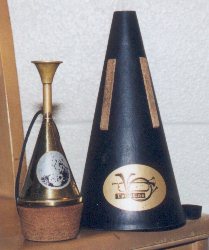
quite poor. In general many professional players in the USA prefer "Rittich"
style mutes, the ones that look like a tall cone. I would by choice recommend a
tunable version of this type of mute. While it may make sense to purchase a
cheap mute for a school program, for personal use always look for something up
the ladder in terms of quality. As to stop mutes, try several if possible and
pick the one with the best projection, as this does vary considerably.
As to a couple specific suggestions, in my opinion one of the
best mute values out there is the tunable "Rittich" style mute made
by Stonelined (Humes and Berg). Working our way up in price, I also like the
TrumCor #45, a Rittich style mute, and really there are many good mutes are out
there (Balu, etc.). Avoid mutes made of aluminum or plastic! For a stop mute Tom
Crown is an old standard, but the TrumCor and Alexander stop mutes are excellent, and there are other new options on the market.
Copyright John Ericson.
All rights reserved. UPDATED
July 2020
Index
Return
to Horn Articles Online |