Understanding Stopped and Muted Horn and Right-Hand PositionStopped horn should not be a mystery John EricsonAn early version of this article was published in the March, 2002 issue of the Texas Bandmasters Association Journal. Stopping the French horn is a mystery to many. Otherwise fine horn players are often quite confused as to exactly how to perform music notated to be performed with the bell stopped by the hand, with reactions similar to the following: "When you close the hand in the bell the pitch goes down--but you are telling me that the we need to finger the note a half step lower when you play stopped?" A first point to consider is the question of why the right hand placed in the bell of the natural horn in the classical period. It was placed in the bell to play diatonic and chromatic passages on the horn and correct for intonation problems. The
basis of the technique of the natural horn is the harmonic series. These are the
pitches that one may sound on an open tube, and are the following.
The Harmonic Series. Several of these pitches are badly out of tune with equal temperament. Players discovered that by inserting the hand into the bell of the horn they could alter the pitch of the instrument for improved intonation and additional pitches, and that they could also make the tonal color darker and more mellow. This technique was known by hornists in the 1720s at the latest. By gradually closing the hand in the bell one can lower any sounding pitch one half step with moderate stopping, and any pitch may be lowered to a half step above the next open pitch by combining full stopping and "lipping" the note down. The natural horn is discussed more fully in this article. Correct hand position for the modern valve horn is closely related to the hand position used on the natural horn. While the hand in the bell does not need to be used to produce diatonic and chromatic notes today, as it was in the Classical period, the hand is still needed in the bell to maintain the proper tonal color and pitch centering of the horn and may be needed to make intonation adjustments. A correct basic right-hand position on the horn is a very
important first element to make stopped horn work correctly. The fundamental
elements of a proper right-hand position are to cup the hand slightly, as though
to hold water in it, and to place it inside the bell so that the backs of the
fingers touch the bell throat, allowing an opening of approximately two inches
between the heel of the hand and the opposite side of the bell. A basically
correct hand position can vary, but there are several issues to consider:
Above all, to
place the hand in the bell with the palm against the inside of the throat of the
bell, as is seen all too frequently in beginners, is totally incorrect. Besides
having a poor, sharp tone, the playing qualities of the horn actually suffer
because of the improper hand position, especially in the upper range of the
instrument.
This leads us
more directly back to our topic, how to perform stopped horn. Stopped notes are
an effect unique to the horn. The basic rule often given for fingering stopped notes on the
horn is to finger the note a half step below the note you want to play, close
the bell tightly with the right hand, and play only on the F horn for
intonation.
As you slowly
close the hand in the bell the pitch will get lower. However, once the bell is
TIGHTLY closed, the pitch will rise or appear to rise by approximately a half step. This is not actually what is happening acoustically (interested music educators should read the discussion in Scott Whitener, A Complete Guide to Brass, third edition, page 57) but a practical way
to think of it as a performer or educator is that you are effectively shortening the horn by "cutting off"
the end of the bell with the hand.
The tightness
of the closure of the bell is quite important; you want to seal the bell with
the right hand. Just as with the natural horn you don't want to "shove the
hand in the bell;" the motion is much more like "closing a door,"
with the hand as the door. A key element to achieving a tight seal for many
players is the thumb. There must be no leakage around the thumb; it helps to
keep the thumb to the side of the palm and first finger. Don't allow the thumb
to leave a hole. Hold the air in just like you would if you were trying to hold
water in the horn bell.
A tight seal is
especially important to the production of stopped notes below the staff. With a
tight seal it is very possible to play stopped horn down to the bottom of the
range of the horn, but when the seal is not tight the notes simply won't come
out with anything approaching the characteristic "buzzy" stopped horn
sound.
If you play
stopped horn on the F side of the double horn pitch will generally be close to
being in tune, raised ½ step above the open notes. If you play stopped on the
B-flat horn though, many notes will be nearly 3/4 of a step higher--in other
words, badly out of tune. Some naturally flat fingerings are however quite
usable on the B-flat side of the double horn; experimentation is very much in
order when in doubt.
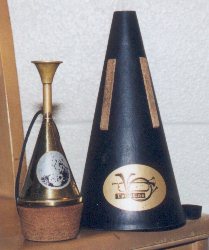
Straight mutes are made by a number of manufacturers, and these only need to be inserted in the bell to get the proper effect--no transposition is required--but it is not a stopped horn sound. Transposing brass stopping mutes are also manufactured to be used as a substitute for hand stopping. These do produce the correct tonal color and also allow for the production of more volume than hand stopping. With this type of mute you will need to transpose and finger, in general, the note a half step lower on the F horn for the best result. For the player struggling with hand stopping it is important to test a stop mute to experience the way the pitch changes. I suggest playing a series of pitches such as the open harmonic series with the normal hand position and then with the stop mute. From the perspective of the player the pitch certainly seems to rise by a half step with the stop mute. There is one final stopped horn effect that should be noted--"half-stopped" notes. Sometimes called echo horn, these notes are performed by closing the bell nearly totally and fingering the notes a half step above the note you want to sound. This effect is specifically requested by some composers (such as Dukas in the well-known horn solo Villanelle [but the Chambers edition changes the notation to stopped]) to obtain a soft, distant sound, as opposed to a buzzy stopped horn sound. This is the same type of hand stopping that would be used on the natural horn as well. To finger for example a C you finger a C-sharp with your normal fingering and close the bell enough with the hand to lower the pitch to C. The burning question many hornists will struggle with is the question of why we think of stopping the horn the way we do on modern horn and why it works at all. The question of what exactly is happening to the pitch of the horn when stopping the bell with the hand has been the subject much study. As noted above, as the bell is closed slowly the pitch goes down but when it is closed very tightly the pitch will rise; some sources say this effect is due to acoustically cutting off the end of the horn with the hand which raises the pitch, while other sources state this is only what appears to happen, as one is actually lowering the next higher overtone to a half step above the previous pitch. The latter approach is correct but In either case, the practical reality is that stopped horn technique as it is taught today for the modern horn relies on this phenomenon, closing the bell tightly and fingering a half step below the desired pitch on the F horn, but this approach to stopped horn technique does not appear to have seen any use before the twentieth century; the hand was always used on the natural horn to lower the pitch of the instrument when closed. Stopping the French horn need not be a mystery. Once understood, it is easy to keep straight why when we close the bell slowly the pitch goes down but with full closure it rises or at least appears to rise a half step. Copyright John Ericson. All rights reserved. Updated October, 2010
|