New TESOL Quarterly Editors
TESOL just announced that Diane Belcher and Alan Hirvela will be co-editors of TESOL Quarterly. Congratulations, Diane and Alan!
Labels: announcement, good news, TESOL
TESOL just announced that Diane Belcher and Alan Hirvela will be co-editors of TESOL Quarterly. Congratulations, Diane and Alan!
Labels: announcement, good news, TESOL
"(Re)Charting the (Dis)Courses of Faith and Politics, or Rhetoric and Democracy in the Burkean Barnyard," an article co-authored by three of my former students at the University of New Hampshire, just appeared in the latest issue of Rhetoric Society Quarterly (38.3).
Congratulations to Mike DePalma, Jeff Ringer and Jim Webber!
Labels: announcement, good news, rhetoric, students
I've been too busy to even keep track of my own work. Here are a few publications that recently came out.
Knoblauch, A. A., & Matsuda, P. K. (2008). First-year composition in the 20th century U.S. higher education: An historical overview. In P. Friedrich (Ed.), Teaching academic writing (pp. 3-25). New York: Continuum.
As the title suggests, this chapter provides an overview of the development of first-year composition--starting with the creation of the first-year composition course in the late 19th century. It also considers the rise of rhetoric and composition as a discipline in the mid 20th century and explores some of the major pedagogical approaches in the 20th century. Abby, by the way, is going to start as Assistant Professor at Kansas State University.Matsuda, P. K. (2008). Myth: International and U.S. resident ESL writers cannot be taught in the same class. In J. M. Reid (Ed.), Writing myths: Applying second language research to classroom teaching (pp. 159-176). Ann Arbor: University of Michigan Press.
This piece examines one of the extreme positions I've seen people take--that ESL writing courses (intensive or first-year) are for international students only and that resident students' needs are too different from international students for them to be placed in the same course. Well, it may be, but given the demographics, all writing teachers--mainstream, basic, or ESL--need to be prepared to work with students who come from various language backgrounds.Matsuda, P. K. (2008). Voice in second language writing: Implications for Japanese learners of English. JACET Summer Seminar Proceedings, No.7: Issues in L2 Writing Instruction (pp. 9-14). Tokyo: The Japan Association of College English Teachers.
This is an outcome of a JACET summer seminar in Kusatsu, Gunma, Japan. (If you are in Japan in August, I highly recommend it.) Based on my earlier study of voice (Matsuda, 2001), I considered the implications of voice for English learners in Japan. While my view on voice encompasses both individual and social voice, I couldn't help but notice that many Japanese students want to develop their own individual voice. That is, they don't want to stand out but they don't want to be the same as everyone else. Individual identiy, after all, is something we create by combining socially available discursive and non-discursive repertoire.Matsuda, P. K., & Atkinson, D. (2008). A conversation on contrastive rhetoric: Dwight Atkinson and Paul Kei Matsuda talk about issues, conceptualizations, and the future of contrastive rhetoric. In U. Connor, E. Nagelhout, & W. Rozycki (Eds.), Contrastive rhetoric: Reaching to intercultural rhetoric (pp. 277-298). Amsterdam: John Benjamins.
Dwight and I often have conversations on various topics in the field (and we often don't agree with one another), and we decided it would be a good idea (and fun) to share some of those conversations with other people in the field. So we tape-recorded one of our conversations when I visited his family cottage on Deer Isle, Main. Steve Simpson transcribed the conversation for us. (He reflects on that experience in Simpson and Matsuda (2008) that I mention below.) We edited it very little, but it sounds remarkably coherent and even handed--it was interesting for us to see what kinds of conversations we often have. (We were aware of the presence of the tape recorder, of course, but after a few beers, it just didn't seem to matter.)Matsuda, P. K., & Tardy, C. M. (2008). Continuing the conversation about voice in academic writing. English for Specific Purposes, 27(1), 100-105. (doi:10.1016/j.esp.2007.04.002)
This is a response to the response that Paul Stapleton and Rena Helms-Park wrote to our article on voice (Matsuda & Tardy, 2007). It may sound pretty strong, but we felt compelled to respond to all the points that Stapleton and Helms-Park raised in their piece. (I've met them both, and they are great people.) Chris and I have a follow-up article on voice (though not in response to this dialogue) that's being considered for publication as we speak.Simpson, S., & Matsuda, P. K. (2008). Mentoring as a long-term relationship: Situated learning in a doctoral program. In C. P. Casanave & X. Li (Eds.), Learning the literacy practices of graduate school: Insiders' reflections on academic enculturation (pp. 90-104). Ann Arbor: University of Michigan Press.
Steve and I wrote this piece during the summer of 2006. I thought of this as a culminating experience for our mentoring relationship at UNH and an important step toward our relationship as colleagues. It was useful for me to reflect on my approach to mentoring and to hear Steve's perspective as well. I was also happy that we were able to receive responses from some of my other mentees, including Michelle Cox, Joleen Hanson, Matt Schneider, and Christina Ortmeier-Hooper. Matt Schneider, who came from San Francisco State to work with me during the summer, observed the whole process of writing this piece. I was lucky to have had the chance to work with these and many other great grad students at UNH, who remain my important colleagues and friends.A list of major publications is available at: http://matsuda.jslw.org/publications.html.
Labels: announcement, applied linguistics, composition, good news, L2 writing, publications, rhetoric
Bryan Smith, a rising star in Computer Assisted Language Learning (CALL), will be joining the English Department in Fall 2008. Bryan will be working closely with students in Master's in MTESOL and Ph.D. Rhetoric/Composition/Linguistics.
Welcome aboard, Bryan!
Labels: announcement, asu, good news
Christina Ortmeier-Hooper's article, “English May Be My Second Language, but I’m Not ‘ESL,’” appears in the most recent issue of College Composition and Communication (59.3).
Here is the abstract: "In this essay, I present three case studies of immigrant, first-year students, as they negotiate their identities as second language writers in mainstream composition classrooms. I argue that such terms as “ESL” and “Generation 1.5” are often problematic for students and mask a wide range of student experiences and expectations."
Congratulations, Christina! Excellent job!
Labels: announcement, good news, students
A collaborative article by Michael-Jon DePalma, Jeffrey Ringer, and James D. Webber has been accepted for publication in Rhetoric Society Quarterly. Congratulations, Mike, Jeff and Jim! Way to go!
Labels: announcement, good news, students
Christina Ortmeier-Hooper has just accepted the position of Assistant Professor of English at the University of New Hampshire, Durham. She will be working with doctoral students in Composition Studies, some of whom are intereted in her expertise in second language writing, among other things.
I'm really happy for Christina and especially for UNH!
Labels: announcement, good news, L2 writing, students
The chapter on mentoring that Steve Simpson and I wrote together just came out:
Simpson, S., & Matsuda, P. K. (2008). Mentoring as a long-term relationship: Situated learning in a doctoral program. In C. P. Casanave & X. Li (Eds.), Learning the literacy practices of graduate school: Insiders' reflections on academic enculturation (pp. 90-104). Ann Arbor: University of Michigan Press.
It provides an overview of my approach to mentoring as well as Steve's perspective on how it worked for him during the first few years of doctoral studies.
It's been fun working with you on this project, Steve!
Labels: announcement, good news, grad school, resources, students, unsolicited advice
A. Abby Knoblauch, my former student at UNH and co-author of the forthcoming chapter on the history of composition, has just accepted a job offer from Kansas State University. Congratulations, Abby! Well deserved!
Labels: announcement, good news, grad school, students
Kate Tirabassi, Assistant Professor English at Keene State College and one of my former doctoral students at the University of New Hampshire, is the recipient of 2008 James A. Berlin Memorial Outstanding Dissertation Award.
The award ceremony will be on Friday, April 4 from 5:00-6:30pm at the Conference on College Composition and Communication in New Orleans, Louisiana.
Congratulations, Kate!
Labels: announcement, good news, students
Mike DePalma, one of my former doctoral students at UNH, just emailed me to let me know that his manuscript on Austin Phelps, a nineteenth-century preacher and professor of sacred rhetoric from Andover Theological Seminary, has been accepted in Rhetoric Review.
Congratulations, Mike! Well done!
The online version of the Encyclopedia of Language and Linguistics, 2nd edition, is now available to ASU faculty and students.
With Margie Berns, I wrote an entry on the overview and history of applied linguistics, but Elsevier somehow managed to screw up my name, so it says "K Matsuda" instead of "P K Matsuda." (The page proof said "P k Matsuda.")
As my daughter is fond of saying, "Oh, man...."
Labels: announcement, good news, 最新情報
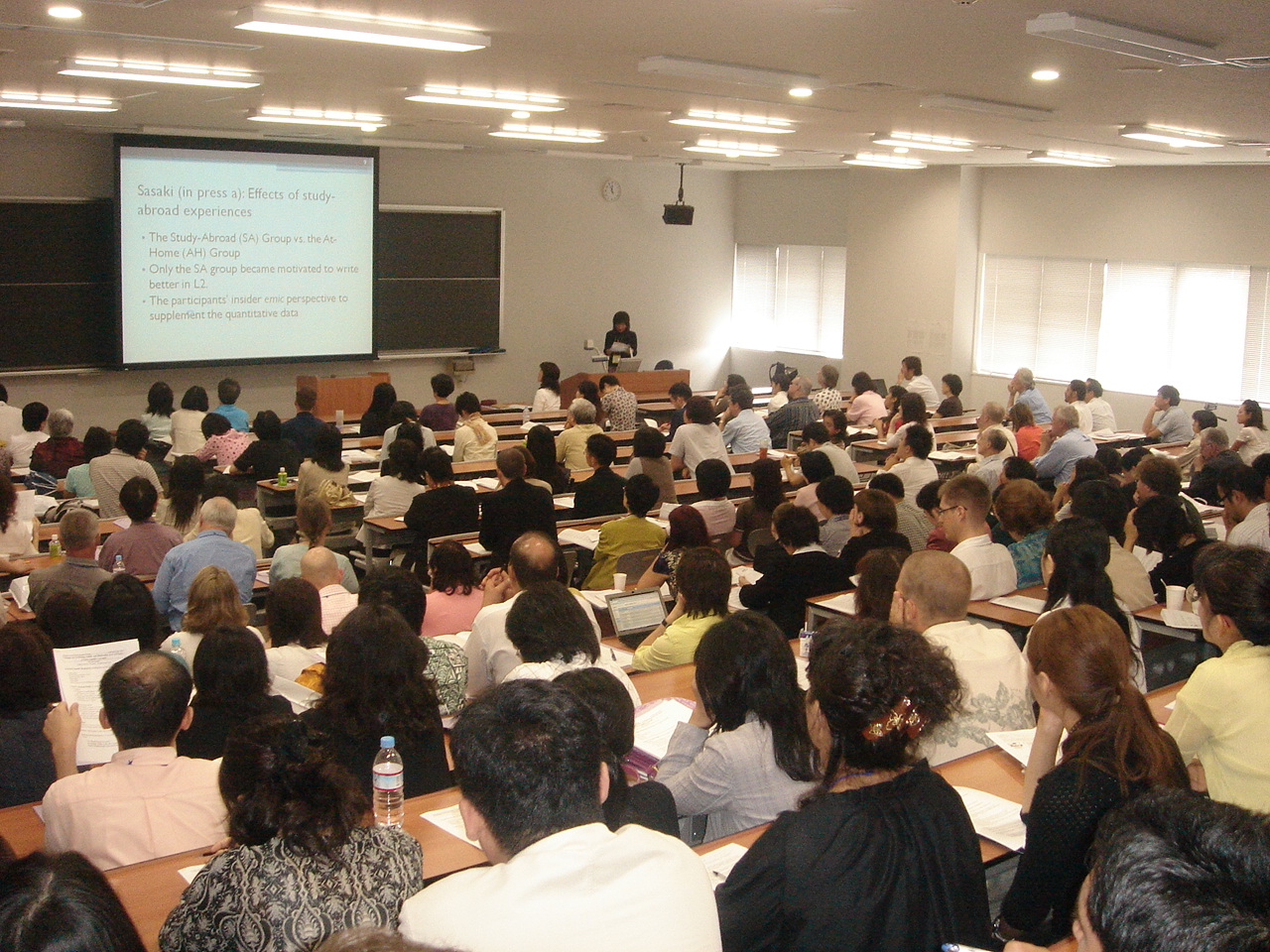
This year's Symposium on Second Language Writing was a huge success. About 340 people from 26 countries participated in the three-day event that took place at Nagoya Gakuin University, home of Miyuki Sasaki, one of the leading L2 writing researchers.
Many people told me that they were impressed by the quality of presentations (as was I) and that they enjoyed meeting people from variuos parts of the Pacific Rim and beyond.
More photos are available here.
The Symposium has now become an annual event, and the next Symposium will take place on June 5-7, 2008, at Purdue University. Tony and his staff will be organizing the 2008 Symposium (including the website), and I'll be working on the 2009 Symposium.
Labels: event report, good news, students, symposium, 報告
Sharon Crowley, my new colleague at Arizona State University, is the recipient of 2007 David H. Russell Award for her recent book, Toward a Civil Discourse: Rhetoric and Fundamentalism (2006). Congratulations, Sharon!
Labels: announcement, good news
I'm happy to report that Gail Shuck of Boise State University is the winner of the 2005-2006 Best Article Award for work published in Writing Program Administration.
The article was part of the special L2 writing issue of Writing Program Administration (Volume 30.1/2, Fall 2006) that I edited with Maria Fruit and Tarama Lee Burton Lamm.
Congratulations, Gail! Well deserved!
Labels: announcement, good news
Chris Tardy and I have just had the fastest publication experience with English for Specific Purposes.
We submitted our initial manuscript, "Voice in Academic Writing: The Rhetorical Construction of Author Identity in Blind Manuscript Review," on September 5, and the reviewers' comments came back in a matter of two weeks--on September 21. Both reviewers suggested "accept with minor revisions," and provided specific and very helpful feedback. We sent in the revised version on October 3 and it was accepted on October 4.
The whole process took only about a month.
Labels: announcement, good news
Christina Ortmeier-Hooper, one of my doctoral students at UNH, has just informed me that her manuscript, "'English is My Second Language, but I'm Not ESL'" has been accepted for publication in College Composition and Communication.
Congratulations, Christina! Well done!
Labels: announcement, good news, students
I just heard from the publisher that The Politics of Second Language Writing: In Search of the Promised Land will be available in the next few days.Labels: announcement, good news, symposium
Aya and I just got a confidencial letter from the Dean's Office, which was hand-delivered to the Department. We also got a letter from the Provost's Office at the same time. It's official now: We are tenured associate professors.
Labels: announcement, good news
Michelle Cox, one of my doctoral students, successfully defended her dissertation--a qualitative study of clinical writing at an on-campus speech clinic. Her work usefully complicates the binary distinction between classroom and workplace writing by examining the writing practice at a site where two activity systems--those of school and workplace--overlap.
The defense went smoothly. It was more a conversation than a defense--as it should be with a quality dissertation. Everyone on the committee--Tom Newkirk, Jess Enoch, Cindy Gannett and John Brereton--seemed to think highly of Michelle's work. She worked really hard in developing her understanding of various theories--situated learning, activity theories, rhetorical genre theories--and in synthesizing them as she prepared for her project. I hope she will continue to pursue this project.
Congratulations, Michelle. Well done!
Labels: announcement, event report, good news, students
Labels: announcement, good news
I received a letter from the Dean saying that my tenure and promotion case has been approved by the Provost. Just a few more steps before it's final. Aya received the same letter for her case. We will be tenured associate professors from this Fall.
My fourth edited collection just came out, and Aya's article on the "perpetual first-year foreign-language teacher" just got accepted for publication.
We went out to celebrate at a Japanese restaurant in Portsmouth, but not the one Don Murray wrote about in his Globe column.
Labels: announcement, good news